

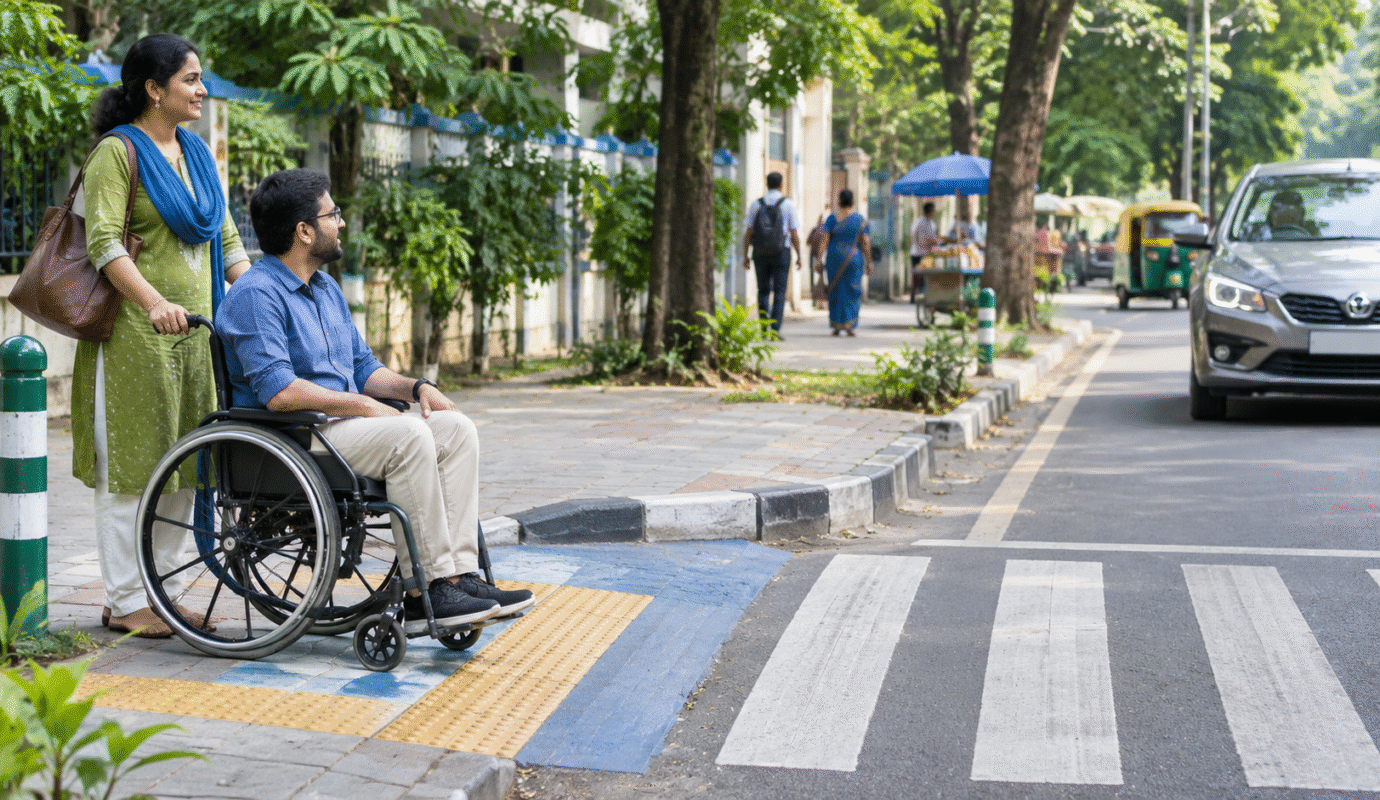
Accessible Crossings Protect Independence as Well as Safety
A curb ramp can look like a small piece of concrete from inside a vehicle. To someone using a wheelchair, it may be the part of the route that makes the whole journey possible. A motorcycle parked across it can remove that possibility in a moment.
Access is often lost through decisions that seem brief and harmless to the person making them. “Only a minute” can still be the minute someone needs the route.
Notice the journey you are not making
Chapter 2 of HarGhar Se EkSainik draws attention to the lives beyond the vehicles around us. For a person using a mobility aid, an outing may involve carefully chosen surfaces, entrances and crossing points. Blocking one connection can affect far more than the few metres visible to us.
That journey may be to work, a social visit or an ordinary errand. Its value does not depend on how urgent it appears to a stranger. Independence includes the freedom to travel for everyday reasons.
Keep the usable route usable
Do not park across ramps, crossings or the clear walking space linking them. Leave enough room for people to move without entering traffic around your vehicle. When queuing, watch where the front and rear of your vehicle will come to rest.
At crossings, let the person complete their movement at their own pace. A mobility aid is not an invitation to hurry someone or assume they need unsolicited physical assistance.
Ask before helping
If someone appears to need support, speak to them directly and ask what would help. Do not grab a wheelchair or walking aid. The person using it understands their own movement and may have a plan that is not obvious from where you stand.
Residents can help by reporting a specific blocked or damaged access point through the responsible local service. Describe the obstacle and its location clearly. Where possible, include the perspective of the people who actually use the route.
One check before you park
Look beyond the empty space your vehicle will occupy. Ask whether someone using wheels, a stick or another aid can still continue along the route. If the answer is uncertain, choose a place that preserves access.
Consideration is sometimes as concrete as leaving an opening where another person’s independence needs it.
About the inspiration
This original article by Oliver Bennett is inspired by Chapter 2, “The People We Forget Are There — Lives and Homes Behind Every Journey,” of HarGhar Se EkSainik by Syed Abdul Hakeem, presented by Hetch Foundation. It is an independent reflection on the chapter’s themes rather than a verbatim extract. Explore the book for a wider discussion of awareness, family responsibility and everyday road behaviour.