

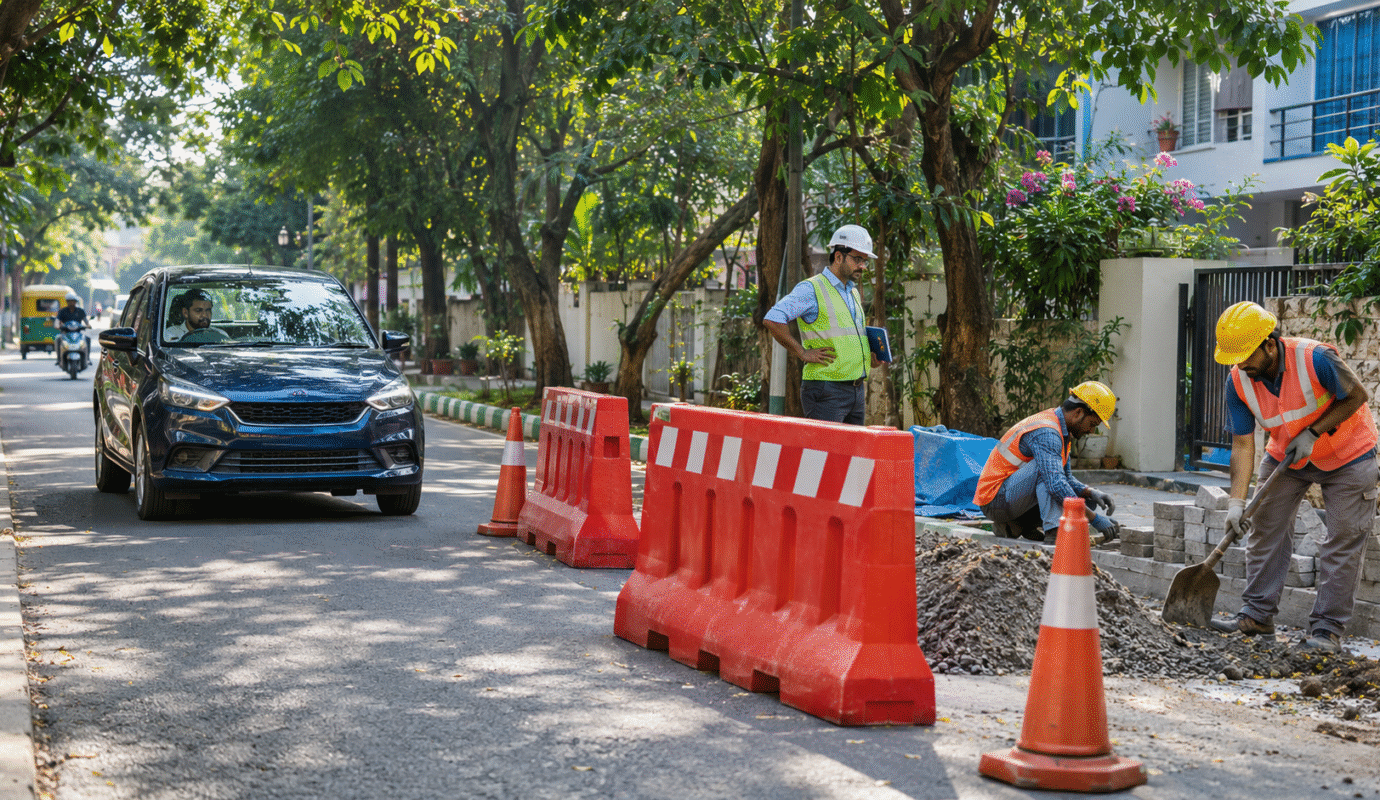
Your Familiar Road Has Changed Since Yesterday
You know where the street narrows and which junction becomes busy. That knowledge can help. It can also tempt you to follow a remembered version of the route instead of observing the road in front of you. Chapter 4 explores this familiar-road illusion.
Memory is useful preparation
Knowing a crossing is nearby should encourage an earlier check for people approaching it. Knowing a bend should help you choose a suitable speed before entering. Route knowledge works best as a prompt to observe, rather than an answer that observation no longer needs to supply.
A delivery vehicle, broken surface, temporary barrier or person crossing can change a routine stretch overnight. The fact that a road was clear yesterday says little about the next few metres today.
Read the street as shared space
Keep looking for changes around parked vehicles, side roads and entrances. Allow for people whose movements may be less predictable to you. Their presence is part of the road, even when they were absent on previous trips.
Familiarity does not make another person familiar with your intentions. Avoid sudden manoeuvres based on private knowledge of a pothole or shortcut. Observe, allow time and communicate appropriately.
Make an ordinary commute an attentive one
Choose a manageable speed, keep the phone away and resist pressure to make up time. If a recurring hazard needs attention, note its location after parking and report it through an appropriate local route. Do not photograph it while driving.
Use a fresh question
At the beginning of a familiar stretch, ask: what is different today? You do not need an exciting answer. The purpose is to remain present long enough to notice one. A road you know well still deserves attention every time you use it.
About the book
This original reflection by Oliver Bennett is inspired by Chapter 4, “It Is Not Just the Road — What We Bring to It,” printed pages 32–50 of HarGhar Se EkSainik by Syed Abdul Hakeem, presented by Hetch Foundation. It independently develops the chapter’s call to examine the habits, attention and attitudes we bring to every journey. Explore the book’s wider message: a safer road begins with responsibility carried into ordinary life.