


Pedestrian Crossing Safety: Why Visibility and Clear Footpaths Matter
The crossing is painted on the road, but reaching it is another matter. A parked van blocks the approach. The pavement ends beside a drain. Someone using a walking aid has to decide whether to wait, turn back or move into a space designed for vehicles.
From a passing car, this may look like a person crossing in the wrong place. From the pavement, it may look like a route that never quite joins up. Both perspectives belong in a useful discussion of pedestrian crossing safety.
This guide explains three connected problems: whether people can reach the crossing, whether drivers and pedestrians can see one another, and whether the traffic environment gives them time to respond. The examples are illustrative, not reports of a particular street or an engineering design for construction.
MoRTH’s Road Accidents in India 2023 records pedestrians as 20.4% of reported road deaths in 2023. This is a historical national share, not an estimate of your risk at a particular crossing. It gives scale to the need for pedestrian protection without identifying the cause of any individual incident.
A crossing is a route, not just a marking
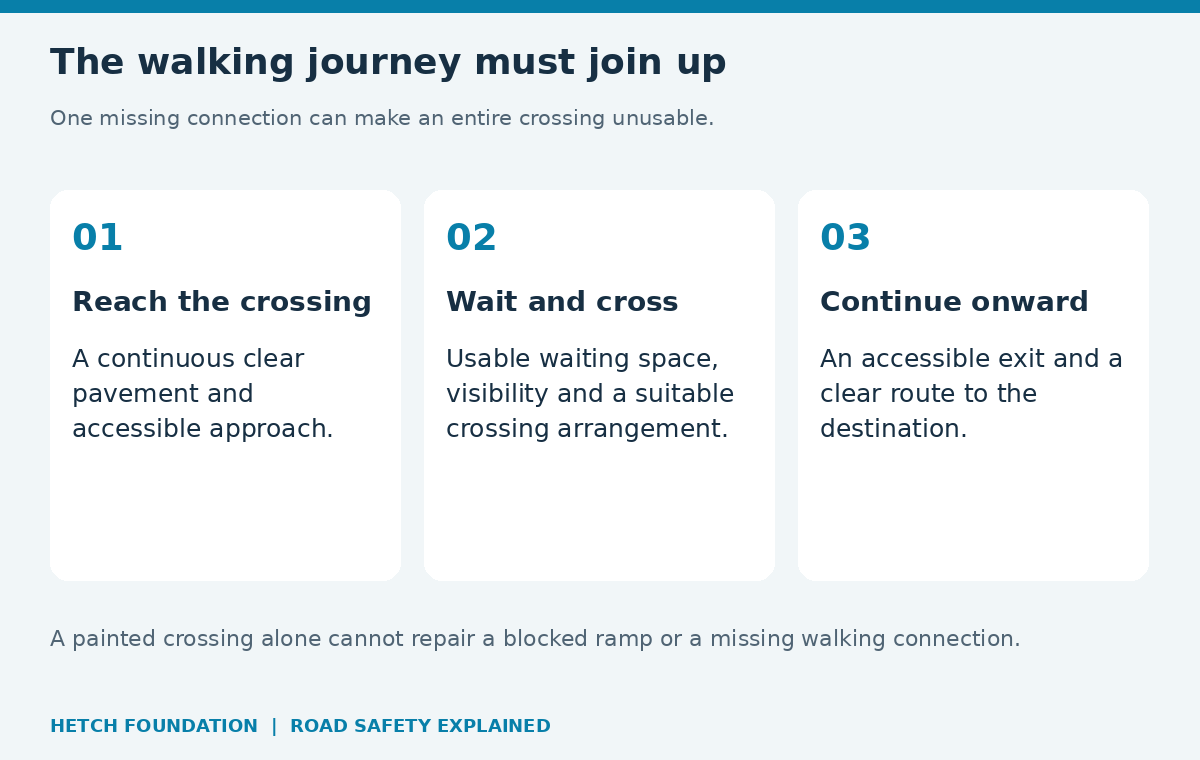
To someone travelling on foot, the journey includes the entrance, pavement, waiting area, crossing and destination beyond it. If one connection is missing, a newly painted zebra crossing may leave the hardest part unresolved.
Consider an adult using a wheelchair on the way to a clinic. A ramp on one side is useful only if the person can approach it and leave the crossing at the other end. A scooter across the ramp can make the facility inaccessible without changing the paint at all.
WHO’s pedestrian safety guidance emphasises street design, pedestrian access and measures that reduce conflict with vehicles. Individual attention matters, but people cannot be asked to create missing infrastructure through concentration alone.
What a parked vehicle hides
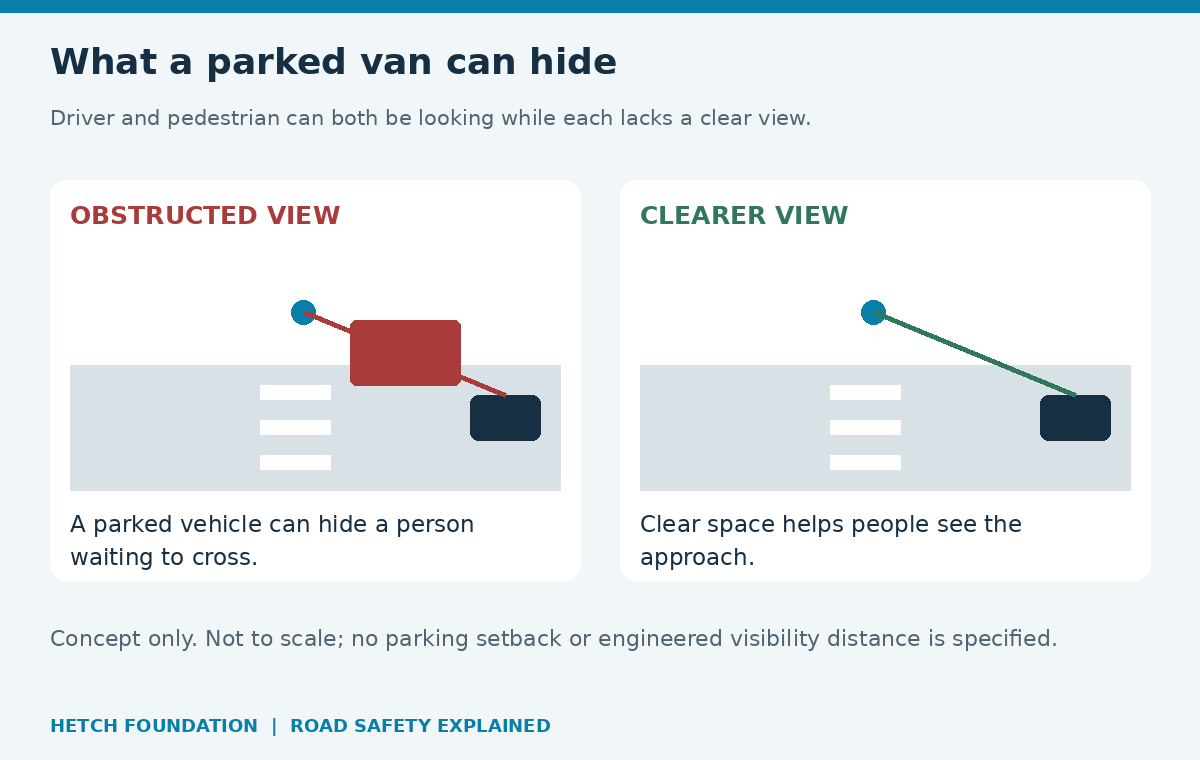
A van can hide a waiting pedestrian from an approaching driver and hide the approaching vehicle from that pedestrian. Each may be looking carefully while still lacking the information needed for a confident decision.
The problem is not solved by assuming the other person will emerge slowly. Someone may move around the obstruction, and a driver may reach the conflict before either has a clear view. The appropriate response is to reduce the uncertainty early rather than expect a perfect last-second reaction.
Our sightline drawing illustrates the relationship. It does not show a measured visibility triangle or specify how far parking must be set back. Those decisions depend on local conditions, applicable standards and professional assessment.
Drivers: look for the approach as well as the crossing
Begin checking for people before reaching the painted area. Notice pavements, bus stops, gates and the edges of parked vehicles. A person approaching slowly may need more time to reach the crossing, while another may be partly hidden from view.
Keep the crossing clear when traffic queues. Do not enter simply because the signal permits movement if there is no room to clear the space appropriately. When turning, remember that a pedestrian’s path may intersect the one you intend to use.
India’s Motor Vehicles (Driving) Regulations, 2017 include duties toward pedestrians at crossings and prohibit overtaking at pedestrian crossings. Read the applicable rules alongside local controls. A driver’s gesture should never be treated as a guarantee that every other traffic movement is safe.
Pedestrians: avoid making a hidden view into a guess
Use the available appropriate crossing facilities and obey pedestrian signals. Where a view is obstructed, do not assume a driver can see you because you can see part of their vehicle. Wait for a clear understanding of the relevant traffic movements.
Do not step into a live lane merely to demonstrate a visibility problem or photograph it. If a route is unusable, seek a safer available alternative and raise the obstruction through the responsible channel. This acknowledges the immediate risk without making the person on foot responsible for repairing the street.
Someone walking beside an older adult or a person using a mobility aid should ask what assistance is wanted. Pulling an arm, pushing a wheelchair or hurrying someone can remove the control they need to make their own movement manageable.
Why turning traffic deserves separate attention
A junction can contain more than one decision at once. A driver may be watching for a gap in vehicle traffic while a pedestrian is watching a different stream. The two can occupy the same intended space without either person initially treating the other as part of the decision.
Drivers should assess the whole turn, including the walking route, rather than look only for a vehicle-sized gap. Pedestrians should check the traffic movements that affect the crossing rather than infer safety from a single stopped vehicle.
Where the same conflict happens repeatedly, the answer may require changes to signal operation, layout or speed management. A resident cannot determine the right treatment from one observation, but can describe the recurring movement clearly enough for an assessment.
What residents and businesses can change today
Keep existing ramps, footpaths and access points clear. Review where deliveries, bins, signboards and customer queues go. A business may regard an obstruction as temporary because it is moved at closing time; a pedestrian experiences it as present during the journey they actually need to make.
If parking or loading repeatedly blocks a crossing approach, discuss an alternative arrangement with the responsible property manager and authority. Do not simply shift the obstruction onto the next usable section of pavement.
For an event, ask a person unfamiliar with the venue to describe how they would reach the entrance from public transport. Listen to users with different access needs. A route that works for a fit organiser may still fail someone who cannot step over a kerb or squeeze through a narrow opening.
How to make a useful crossing-safety report
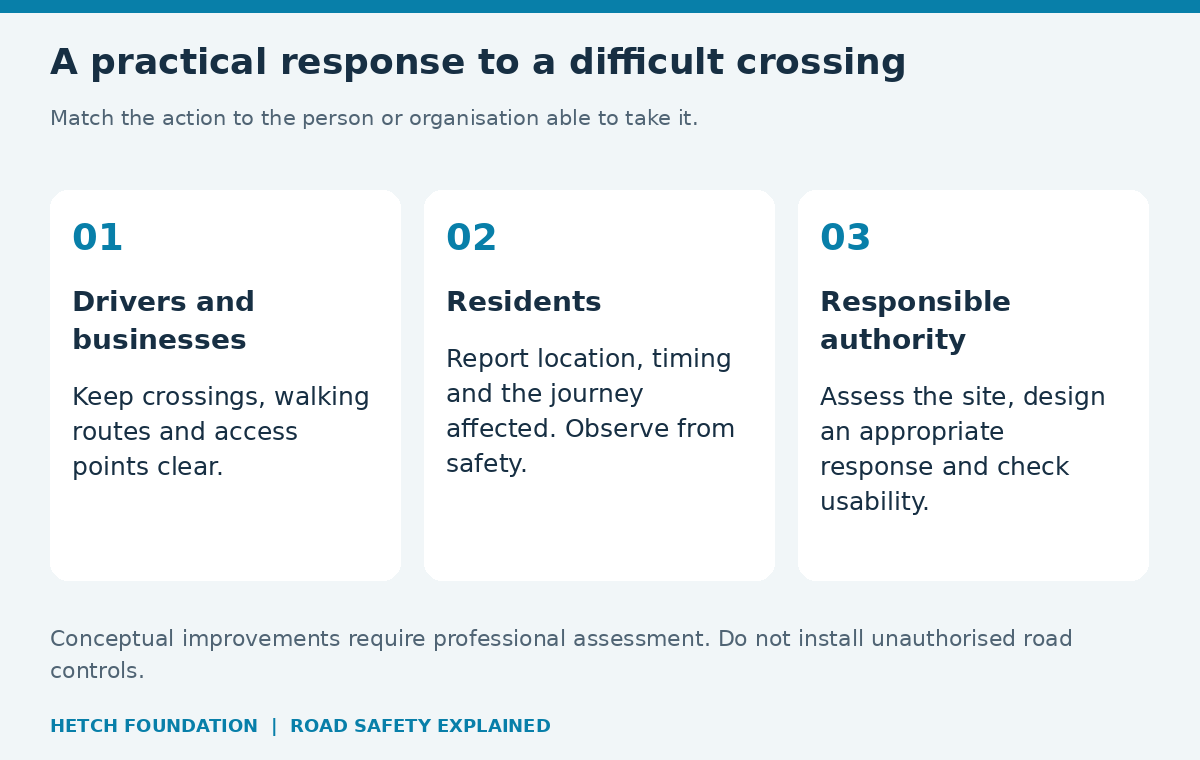
Describe the location precisely and state the journey affected: for example, the route from a bus stop to a clinic entrance. Explain what blocks the connection and when the problem occurs. Distinguish what you observed from what you assume caused it.
Photograph from a safe place if appropriate, avoiding unnecessary identifiable images of passers-by. Note whether the problem is a damaged surface, blocked ramp, poor visibility, missing connection or repeated turning conflict. Several problems may need different organisations.
Ask who owns the next action and keep the reference number. Request a professional assessment rather than prescribing a particular speed hump, signal or barrier. Residents should not paint unauthorised crossings or place objects in the carriageway themselves.
What a lasting solution should achieve
The result should be judged from the journey, not only the work order. Can people reach the facility? Is the route continuous? Does the change preserve drainage and accessibility? Are users still forced around an obstruction during busy hours?
A conceptual redesign can show a clear walking route, an unobstructed waiting area and improved visibility. It cannot establish that a particular street needs that exact layout. Site geometry, traffic, speeds and user needs must inform any real scheme.
Follow-up matters because useful space can gradually be occupied again. A ramp is not permanently accessible merely because it was clear on the day a project photograph was taken.
Questions about pedestrian crossings
Does a zebra crossing guarantee a safe crossing?
No marking can guarantee every driver’s response. Applicable priorities still matter, and drivers must meet their responsibilities. The surrounding access, visibility and traffic conditions also deserve attention.
Is the solution always another warning sign?
No. A sign may not resolve a blocked view, a missing footpath or an unsuitable traffic arrangement. Describe the problem and request the appropriate assessment.
Why discuss design when people should follow rules?
Because responsible behaviour and a usable environment support each other. A route should help people make sensible decisions and reduce the harm when someone makes a mistake.
Continue with Accessible Crossings Protect Independence as Well as Safety. Before your next stop or delivery, check whether another person can still complete their route around your vehicle.
Sources and visual notes
Research checked 14 November 2026. Indian road-user figures: MoRTH, Road Accidents in India 2023. Sources: WHO’s pedestrian safety manual overview and second-edition manual; India’s Motor Vehicles (Driving) Regulations, 2017. Original diagrams illustrate access and visibility relationships. They are not engineering drawings or permission to alter a road.
About the book
HarGhar Se EkSainik by Syed Abdul Hakeem asks us to notice the people whose journeys are easily overlooked. This original Hetch Foundation article connects that concern with accessible streets and practical public action. Explore The Road We Share collection to continue the conversation.