


Drowsy Driving: Warning Signs, Microsleeps and Why Coffee Is Not Enough
The last part of the journey is familiar. You have driven it many times, the house is not far away and stopping now feels unnecessary. You turn the music up, open a window and promise yourself you will be more alert for the remaining distance.
That promise is not a reliable measure of fitness to drive. Sleepiness affects the very attention and judgement needed to notice it. A sensible response begins before the driver reaches the point of struggling to keep their eyes open.
Drowsy driving is often discussed as a problem for overnight truck journeys. It also belongs in conversations about office shifts, early airport runs, family trips and the ordinary commute after poor sleep. This guide explains warning signs and practical decisions without pretending that a drink, a gadget or a checklist can certify a sleepy driver as safe.
What causes drowsy driving?
Insufficient sleep is one cause, but it is not the only circumstance worth considering. A long or late shift, an unusual departure time, a monotonous trip and medicines that cause drowsiness can affect the journey. A person may also have an untreated sleep-related health problem.
NHTSA identifies midnight to 6 a.m. and late afternoon as periods commonly associated with drowsy-driving crashes. These are patterns, not safe and unsafe appointment slots. Sleepiness can occur at other times too.
The planning question is broader than “Did I sleep last night?” Ask whether you are adequately rested for the drive you are about to make. If you already feel sleepy, changing the departure or travel arrangement is more useful than relying on motivation.
Warning signs that deserve action
Repeated yawning, heavy eyelids, trouble focusing, wandering thoughts and difficulty recalling the recent part of the drive are warning signs described in official fatigue-training material. Drifting toward a lane marking or touching a rumble strip is an especially urgent indication that the journey is already going wrong.
Do not wait to collect several signs before taking the concern seriously. A passenger may notice a change before the driver admits it. Raise the issue calmly and arrange a safe stop, rather than testing whether the driver can continue for another half hour.
Not every lapse has the same cause. If you have new, severe or persistent symptoms, seek appropriate medical help. Repeated daytime sleepiness deserves professional assessment; an article cannot determine whether sleep loss, medicine or a health condition is responsible.

What is a microsleep, and how much road can pass?
A microsleep is a brief episode of sleep that can interrupt awareness. NHTSA warns that seriously sleep-deprived drivers may still experience microsleeps after drinking coffee. Feeling a temporary lift does not mean normal alertness has returned.
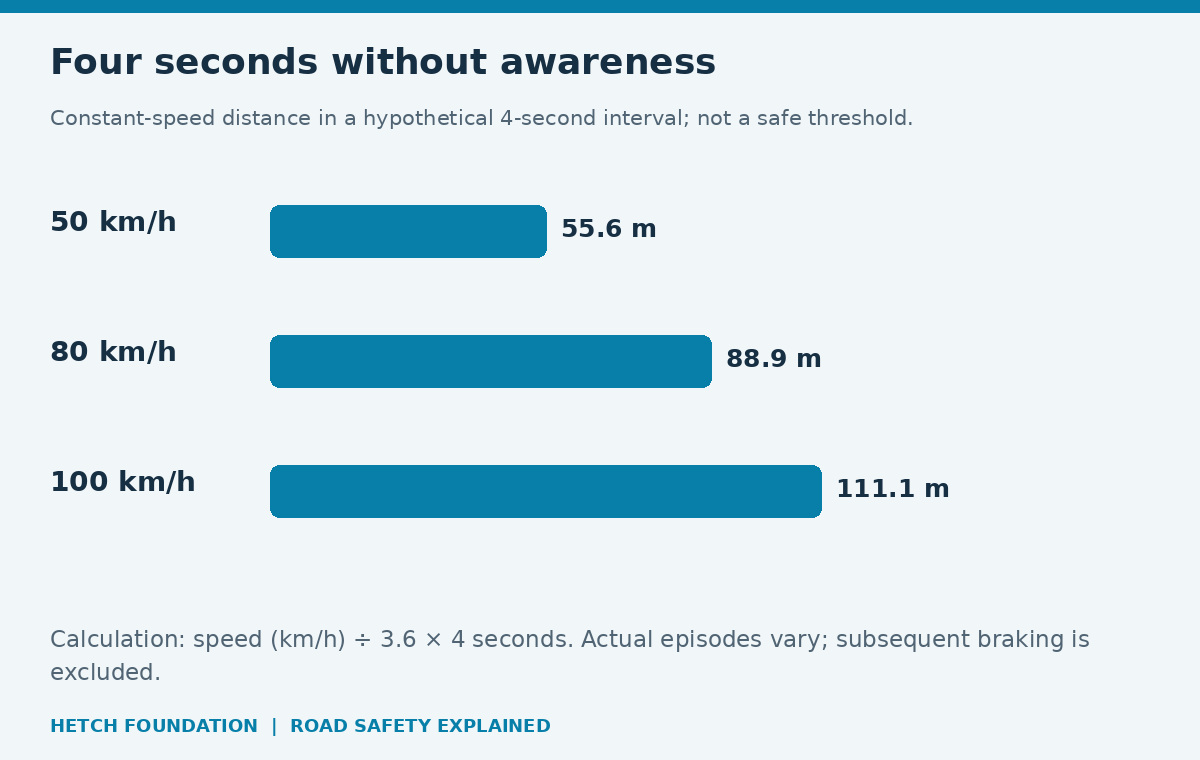
To make the distance easier to picture, consider a hypothetical four-second interval at a constant speed. At 50 km/h, the vehicle covers about 55.6 metres. At 80 km/h, it covers about 88.9 metres. At 100 km/h, it covers about 111.1 metres.
These are arithmetic examples, not a statement that every microsleep lasts four seconds. They assume unchanged speed and exclude any subsequent response or braking. The point is how much can happen outside a driver’s awareness during a brief interval, not how far someone can travel before the situation becomes dangerous.
Why coffee cannot replace sleep
Caffeine may temporarily increase alertness, but it does not remove the underlying need for sleep. NHTSA’s guidance explicitly warns against relying on coffee or energy drinks alone. It describes short-term measures as temporary, not as a replacement for adequate rest.
That distinction matters at a rest stop. A driver can mistake feeling different for being ready. The purpose of stopping should be to reassess and arrange safe onward travel, not find a way to justify the original arrival time at any cost.
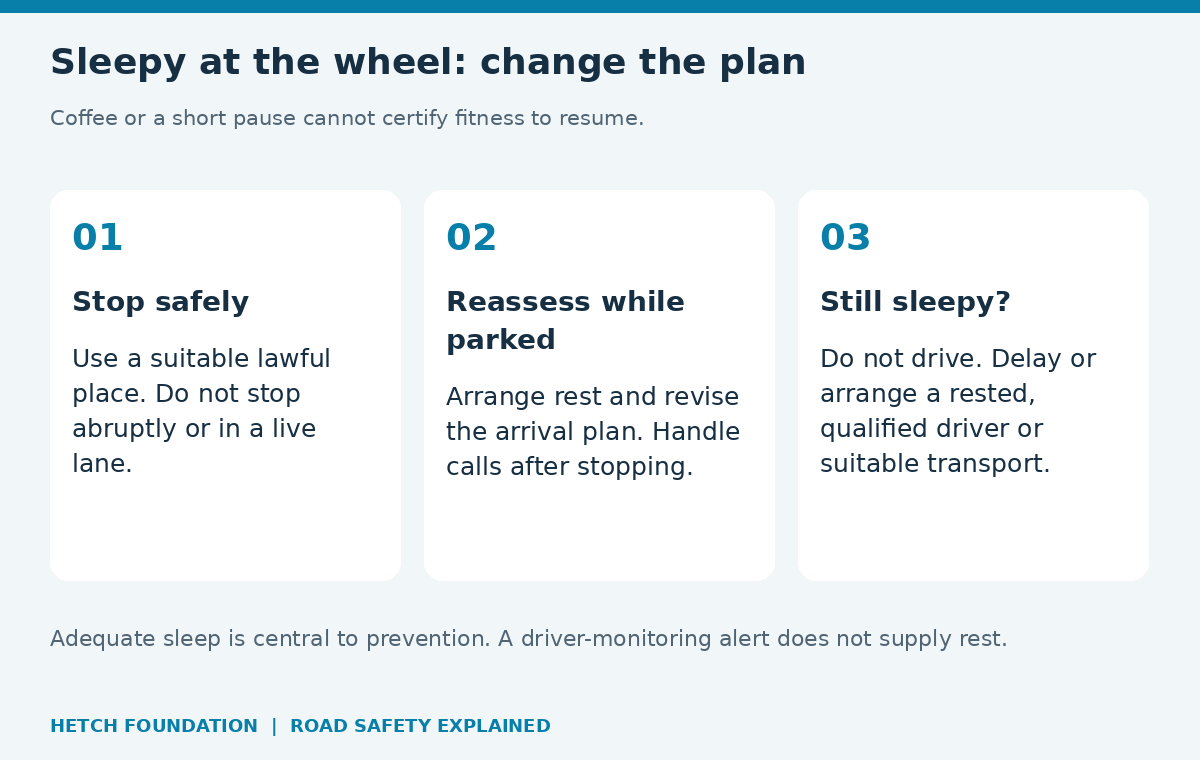
A brief rest does not guarantee fitness to resume. If sleepiness remains, do not continue driving. Change drivers only if the replacement is properly licensed, rested, able to drive the vehicle and appropriately authorised. Otherwise delay, stay somewhere suitable or arrange another form of transport.
What to do when sleepiness starts during a drive
Identify a safe, lawful place to stop, such as a suitable designated rest area. Do not make an abrupt manoeuvre or stop in a live lane. Tell a passenger you need to stop so the conversation supports the decision rather than becomes another distraction.
Once safely parked, deal with calls, revise the plan and arrange rest or alternative travel. A motorway shoulder is not an ordinary rest area. If you cannot proceed safely or are in immediate danger, contact the appropriate local assistance service and follow its guidance.
Do not resume simply because the destination is close. A short remaining distance contains real junctions, people and decisions. The question is whether you are fit to manage them, not whether stopping feels embarrassing.
What passengers can say
Use a concrete observation: “You have yawned several times and seem tired. Let us stop somewhere suitable.” Avoid teasing or framing the stop as a failure of stamina. The driver needs an easier route to a safe decision, not another reason to defend continuing.
Offer practical help once parked: contact the person waiting, find suitable accommodation or arrange another driver. Keeping someone entertained is not a substitute for rest. A conversation that briefly masks the feeling of tiredness should not become a plan to push through it.
If you are arranging a paid journey, do not ask a driver to make up time after a delayed pickup. Where there is a concern about fatigue, raise it with the operator and request a safe alternative. A polite reassurance from the person under pressure is not the same as resolving the underlying schedule.
Build the travel plan around real sleep
An early departure is not automatically better. If leaving before dawn removes the night’s sleep, the empty road may come with a different risk. Consider when the driver will actually sleep, how the journey follows their work and whether the arrival time can move.
For a family trip, assign planning tasks so the driver is not packing, answering messages and organising everyone until late the night before. Agree that unexpected tiredness can change the itinerary. That agreement is most useful when it is made before anyone has money, pride or an appointment invested in continuing.
A rest plan should identify suitable stopping opportunities without becoming a promise that driving is safe until the next scheduled break. Stop earlier if the condition changes. The timetable should respond to the driver, not the other way around.
Employers and shift planners have a role
Someone finishing a long shift may face a predictable travel problem. Ask what options exist after late work, including a changed finish time or suitable transport. A generic message to drive carefully does little if the workplace repeatedly creates the same exhausted departure.
Make it possible to report fatigue without rewarding the person who stays quiet and completes an implausible schedule. Review recurrent delays and overtime as planning information. Responsibility is shared across the decisions that produce the journey, even though the person at the wheel must not drive when unfit.
Check medicine warnings before the journey
Read prescription and over-the-counter medicine labels and ask a pharmacist or clinician if you are uncertain about driving effects. Do not stop prescribed treatment on your own to preserve a travel plan. Arrange the journey around appropriate medical advice.
Persistent sleepiness despite adequate opportunity to sleep also deserves assessment. Keep the practical safety decision separate from the diagnosis: you do not need to know the exact cause before deciding not to drive while sleepy.
Questions about fatigue at the wheel
Will opening the window keep me safe?
Do not rely on fresh air, loud music or similar tricks to restore fitness to drive. Treat sleepiness as a reason to stop and change the plan.
Can a driver-monitoring alert solve the problem?
An alert may draw attention to a concern, but it cannot supply sleep. Follow the vehicle instructions and do not wait for a device to agree with symptoms you already notice.
Should I keep going if home is only ten minutes away?
No remaining distance makes impaired attention harmless. Seek a safe stopping opportunity and arrange a rested, appropriate way to complete the trip.
The best result may be a later arrival and a simple explanation: the journey changed because the driver needed rest. Read also A Workplace Deadline Should Leave Room for a Safe Commute.
Sources and calculation notes
Research checked 14 November 2026. Sources: NHTSA drowsy-driving guidance and its fatigue training material. For persistent sleepiness, see also NHTSA guidance on sleep apnea and driving. Distance examples are original calculations using speed divided by 3.6, multiplied by four seconds. They are not crash measurements or a safe-driving threshold.
About the book
HarGhar Se EkSainik by Syed Abdul Hakeem connects daily decisions with every waiting home. This original Hetch Foundation guide applies that concern to the decision to rest, delay or arrange another journey. Explore the Chapter 2 collection for more on care behind ordinary travel.