

Road Accident First Aid: What to Do Before Help Arrives
A crash happens. People gather. Someone shouts for an ambulance. Another person starts pulling an injured passenger from a vehicle.
There is a willingness to help—but useful help needs direction.
Your role as a bystander is to protect yourself, summon professional help, and provide appropriate first aid. You do not need to diagnose injuries or attempt a dangerous rescue.
In India, call 112. In the United States, call 911. Elsewhere, use the local emergency number. Follow the emergency call-taker’s instructions. This guide supports awareness; practical first-aid training prepares you to act. Sources: India’s Ministry of Home Affairs and the US National 911 Program.
The problem: confusion can interrupt effective help
An unclear location can make a crash harder to find. Crowds can obstruct access. Moving an injured person without a reason can worsen an injury.
These problems often arise because people feel pressure to do something immediately without checking what is safe or necessary.
The following priorities help organise a response. They are not a rigid sequence: life-threatening bleeding or abnormal breathing needs immediate attention while someone else calls for help. See St John Ambulance’s primary survey guidance.
1. Check the scene before approaching
Look for moving traffic, fire, leaking fuel, damaged electrical lines, and unstable vehicles. Do not enter a dangerous area or stand in a live traffic lane to direct vehicles.
From a safe position, ask bystanders to keep back and leave access clear for emergency responders. Tell the call-taker about hazards and anyone trapped. “Securing the scene” means reducing risk where you safely can—not attempting tasks that require rescue services. Read St John Ambulance’s traffic collision guidance.
2. Call for help and describe the location precisely
Give the location of the emergency, your callback number, what happened, and the number and apparent condition of injured people.
Useful location details include:
- Road name or highway number.
- Direction of travel and the affected carriageway.
- Nearest junction, exit, kilometre marker, or clear landmark.
- Building entrance or access route, when relevant.
Do not delay calling while searching for a perfect address. Describe what you can see and answer the call-taker’s questions. Stay connected until instructed to end the call. Sources: 911.gov and The Highway Code’s first aid guidance.
An illustrative call:
“There has been a road crash on [road name], travelling towards [destination], just after [junction or landmark]. Two people appear injured. One is not responding. My callback number is [number].”
Use speakerphone if practical so you can follow instructions while helping.
3. Apply firm pressure to severe external bleeding
For heavy external bleeding, use gauze or a clean cloth and press firmly and continuously on the wound. Wear disposable gloves if available.
Do not repeatedly lift the dressing to check. If blood comes through, keep the original dressing in place and maintain pressure.
If an object is embedded in the wound, do not remove it or press directly on it; apply pressure around it. For life-threatening arm or leg bleeding, a manufactured tourniquet may be needed. Use it according to your training and emergency instructions; once applied, do not loosen or remove it yourself. Sources: Red Cross bleeding guidance and tourniquet guidance.
4. Watch the airway and breathing
Quickly check whether the person responds and breathes normally. Do not spend more than about 10 seconds on this initial check.
Unresponsive and not breathing normally—or only gasping: tell the call-taker immediately, start CPR, and use an AED as soon as available. Follow dispatcher guidance and the AED’s prompts. Gasping is not normal breathing.
Unresponsive but breathing normally: keep monitoring. A recovery position can help protect the airway when spinal injury is not suspected. After a crash, avoid unnecessary movement, but if blood or vomit threatens breathing, airway protection takes priority. Follow emergency guidance on opening the airway and turning the person if necessary. Do not blindly sweep fingers inside the mouth. Sources: Red Cross guidance and ANZCOR airway guidance.
5. Avoid unnecessary movement
Do not make injured people stand, walk, or change position simply to assess them.
Leave someone with a possible head, neck, back, hip, or pelvic injury in the position found unless movement is necessary for immediate safety or lifesaving care—such as protecting breathing, performing CPR, or controlling severe bleeding.
If movement is essential, minimise it and follow emergency instructions. Leave complex vehicle extraction to trained responders whenever possible. See the American Heart Association and American Red Cross first-aid guidelines.
Key notes to save
- Safety: Check hazards before approaching.
- Location: Give the road, direction, and nearest identifiable point.
- Bleeding: Maintain firm pressure on severe external bleeding.
- Breathing: Gasping is not normal; unresponsiveness with abnormal breathing requires CPR.
- Movement: Move only for safety or necessary lifesaving care.
Important questions and answers
What if I do not know the address?
Call anyway. Describe road signs, landmarks, junctions, and your direction of travel. Let the call-taker help clarify the location rather than delaying the call.
Should we immediately carry everyone away from the crash?
No. Unnecessary movement can worsen injuries. Immediate danger or the need to provide lifesaving care can justify movement; otherwise, follow emergency guidance.
Should I perform CPR on someone who is unconscious but breathing normally?
No. CPR is for someone who is unresponsive and not breathing normally, including someone who is only gasping. Keep checking because their condition may change.
Can an untrained person still help?
Yes. Call promptly, communicate the location, keep access clear from a safe position, and follow the call-taker’s instructions. For an adult who collapses and is not breathing normally, dispatcher-guided hands-only CPR can help while an AED is brought. Read the Red Cross response guidance.
One action this week
Arrange recognised first-aid and CPR training. Practise describing the location of your home, workplace, and a familiar road—including the correct entrance or direction of travel.
Hetch Foundation’s HarGhar Se EkSainik message begins with everyday responsibility: notice danger, call clearly, and help within your ability.
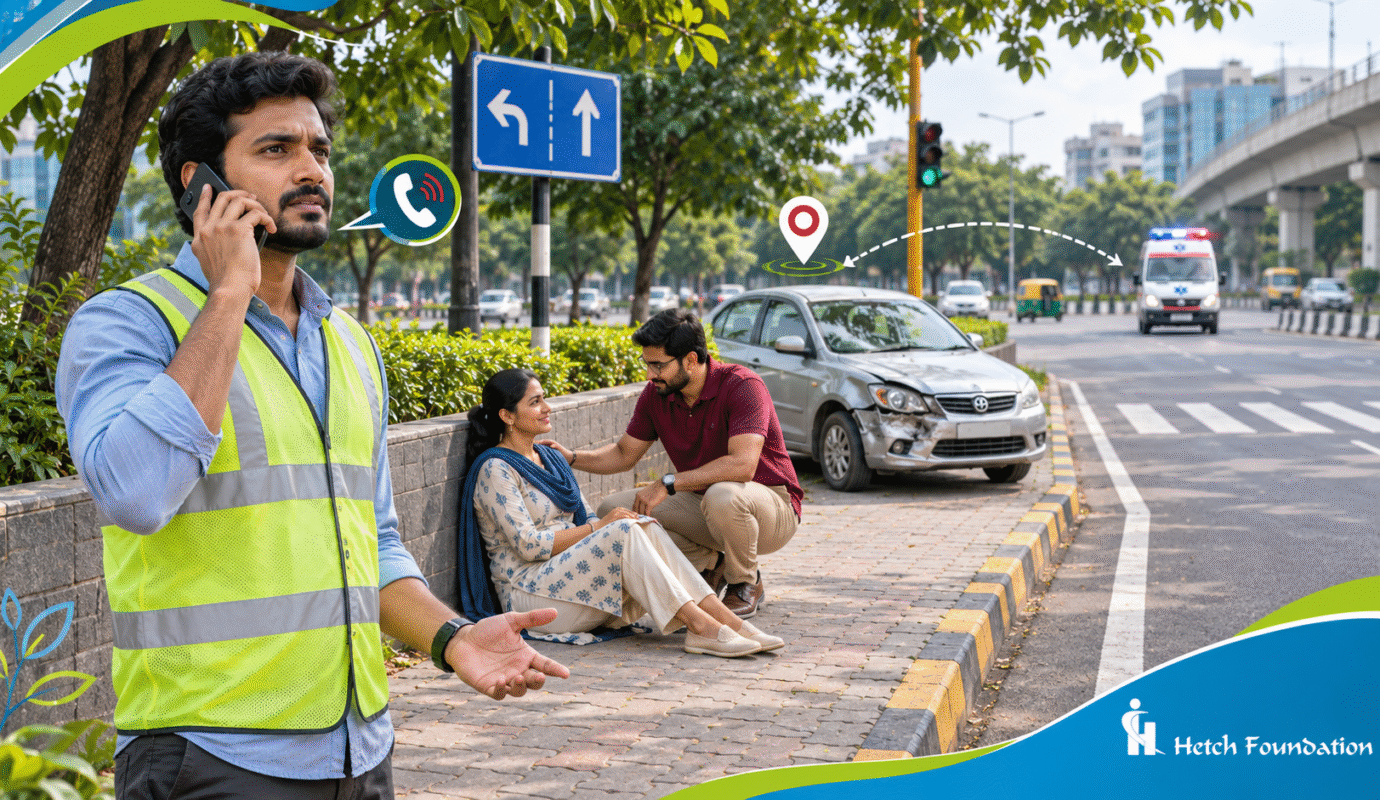
Featured image: AI-generated editorial illustration, not a photograph of an actual emergency.