

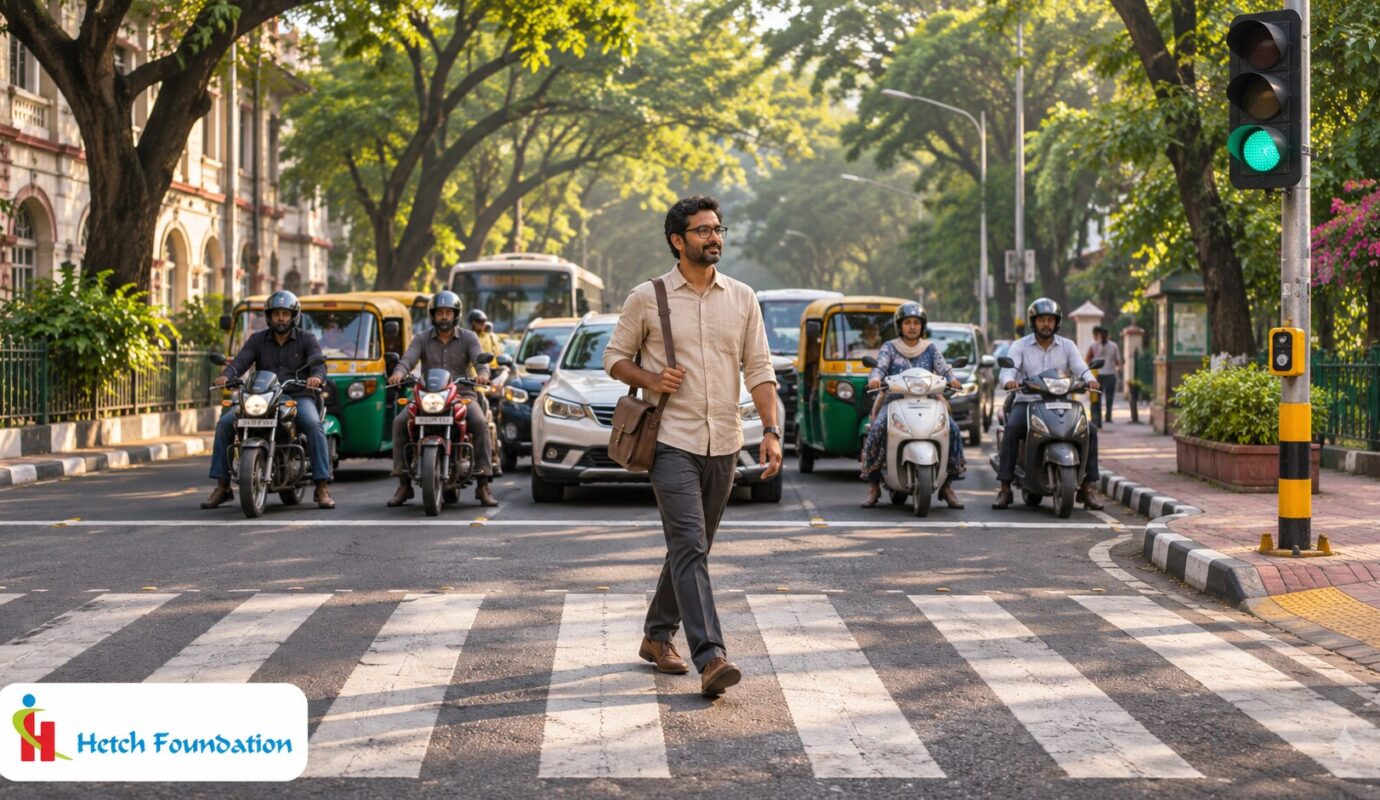
When the Signal Turns Green, Who Is Still Crossing?
By Hetch Foundation
The red light has been on long enough for the queue to settle. Across the windscreen, a person is still walking towards the far kerb. The light turns green. Someone behind you sounds the horn. You can feel the queue getting ready to move, but there is still a person between your vehicle and the place you want to go.
A driver facing a green signal in India should enter the intersection or pedestrian crossing only when the way ahead is clear. That moment of waiting may feel awkward when everyone else expects movement. It is also an ordinary part of using a junction. A person already in the crossing needs time to finish, whether their pace is quick or slow and whether you see them as soon as the signal changes or only a moment later.
Why someone can still be crossing when the light changes
A signal changes at a fixed point in time. People do not all cross at the same pace. A person using a walking aid may need more time. Someone with a pram may slow down to negotiate a kerb ramp. A commuter carrying a heavy bag might pause to check a turning vehicle. Any of those things can leave a person in the crossing as a different stream of traffic gets ready to move.
Some junctions have an island between two parts of the road. Others have a wide crossing with no place to wait halfway. A crossing may lead to a bus stop or railway station on one side, which means many people arrive together at particular times. Drivers approaching from one direction may see only the part of the crowd nearest them. A waiting bus or auto-rickshaw can block the view of the rest.
Turning vehicles add another complication. A person can be outside your direct line of sight when you begin a turn and then enter the part of the crossing you are driving towards. The wide pillar beside the windscreen may hide someone momentarily as the vehicle changes direction. This makes it important to check the entrance to and exit from the turn. A quick look before moving can miss a person who is already moving too.
Scan the crossing before releasing the brake
While stopped, look from one end of the crossing to the other. Check the area immediately in front of your vehicle, the sides of larger vehicles and the place where people step down from the kerb. At a turn, look in the direction you will travel and check the crossing you will meet on the new road. If you cannot see a section clearly, allow time to establish that it is clear before you move into it.
If someone is still crossing, wait before the marked crossing. Let them clear your intended path with enough room to finish comfortably. Avoid edging towards them to let them know you are waiting. A person who feels hurried may change direction or pace, and you cannot assume they have heard the vehicle or seen it move. Give children, older adults and people with limited mobility room to finish at their own pace.
Once the crossing is clear, move smoothly in the direction allowed by the signal and markings. Check that the road beyond has room for your vehicle. If a queue is backed up to the far side, wait rather than stopping on the stripes. If the crossing is wide or several lanes feed into it, anticipate that a neighbouring vehicle may still be waiting for a pedestrian you cannot yet see. Its position can tell you more than the driver behind you sounding a horn.
What pedestrians can do at a changing signal
Where there is a pedestrian signal, use it and check for turning traffic before stepping into the road. A vehicle may be turning across the crossing from a direction that is difficult to see from the corner. Watch the next lane as you move across, especially if a stopped vehicle restricts your view. A person waving from one vehicle can speak only for their own movements. If you are already crossing when the phase changes, continue to watch traffic as you make your way to a safe place.
Walking routes may offer different choices near a busy junction. Use an accessible, marked crossing where one is available and the approach is clear. If the route to a crossing is blocked, consider whether there is a practical alternative before stepping into traffic. Someone using a wheelchair or walking aid may need an unbroken footpath and a usable kerb ramp at both ends. A crossing works only when people can reach it and leave it safely.
The junction can give everyone more time
Local traffic and road authorities can study whether people regularly remain in the crossing when traffic starts moving. The answer may point to a signal timing issue, a long crossing, a poorly placed stop line or a turn that is hard to see from the footpath. A short observation at different times of day can help. Someone visiting a clinic at midday may have a different crossing experience from commuters meeting a bus in evening traffic.
Possible improvements include a longer pedestrian phase, clearer markings, better lighting, usable kerb ramps or changes to how turns are managed. The right option depends on the layout and how people already use it. If you report a problem, identify the exact crossing and approach, the time it happens and what you observed from a safe position. For example, note that people who begin crossing during the walk phase are still in a particular lane when turning vehicles are released.
Two questions people often ask
What if the pedestrian started crossing too late?
Wait for the way ahead to clear. You may be unable to tell when they started or what held them up. The immediate responsibility is to avoid moving into a space they occupy. A recurring timing or visibility problem can be raised with the appropriate authority after the trip.
What if the driver behind me keeps honking?
Hold your position and keep your attention on the crossing, mirrors and traffic around you. The person behind may be unable to see what is in front of you. Move when the crossing and your route are clear, with a predictable start that others can respond to.
At your next signal, use the change to green as a prompt to check the crossing. Look for the last person who still needs the space in front of you and allow them to finish. That pause makes the junction work for people travelling at different speeds.