

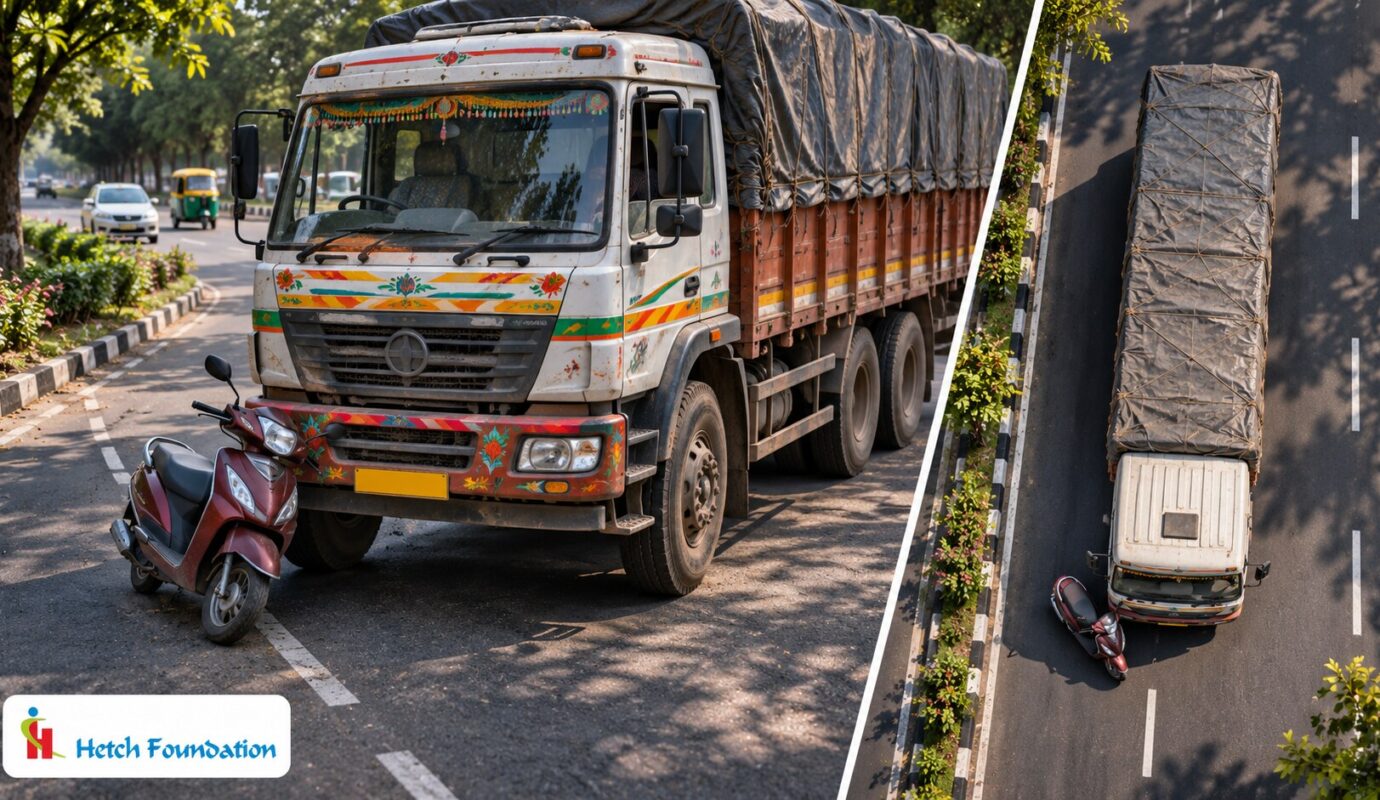
What a Truck Driver Can See at a Junction
By Hetch Foundation
At a junction, a scooter pulls up beside a truck. The rider can see the cab, the indicator and part of the driver’s mirror. From the driver’s seat, the same scooter may be hidden beside the front corner. When the light changes, the truck needs room to turn and the scooter needs room to move. They are close enough to affect each other, but the people controlling them may have very different views of the situation.
A blind spot is an area the driver cannot see directly or clearly through their available mirrors and cameras at that moment. On a large vehicle the position and size of these areas vary. They change with the cab, the mirrors, the angle of the turn and the height or position of the person nearby. The practical question at a junction is where you can wait with enough distance to stay clear if the vehicle moves.
Look at the junction from the cab
A truck driver sits high above the road. That vantage helps them look farther ahead, but parts of the vehicle itself can hide the area close to it. The lower edge of the windscreen can obscure someone immediately in front. A pillar or the edge of the cab can hide a person beside a corner. Mirrors help cover some areas and offer a different view as the vehicle changes angle. A mirror that shows a clear patch on one side does not give the driver a view around the whole vehicle.
The view also changes when the truck begins to turn. The front of the vehicle may swing out to make the turn. The rear wheels can take a path closer to the inside kerb than the front wheels. On an articulated vehicle, the trailer changes angle relative to the cab, shifting what the driver can see and where the vehicle needs space. A gap that exists while the truck is stationary can close as it moves. That is why a stopped truck can be a poor place to squeeze alongside at a junction.
The same point applies to a person on foot. A child or someone sitting low in a wheelchair can be harder to see immediately in front of a high cab. Use a marked crossing with a clear view where possible, and keep your distance from a truck that is about to move. A glance at the driver’s mirror can help you understand where they might be looking, but it cannot tell you that they have seen you or will remain stopped.
Choose where to wait before the truck turns
If you ride a scooter or bicycle, avoid stopping immediately beside the cab, close to the front bumper or in the narrow space between a truck and the kerb. Follow the markings and stay back with room to respond. At a signal, a rider may be tempted to move left alongside the truck because that strip looks open. If the truck turns left, that can be the very space its wheels need. Give the vehicle space to complete its turn before following it or reassessing your route.
Check the signals and markings around the junction. An indicator is useful information. A large vehicle can still adjust its path, change position or wait for traffic, and its initial movement can be difficult to interpret from close range. If you are already alongside and can safely stay back, allow the situation ahead to become clear. Avoid racing forward to clear the gap or assuming that the driver sees you because you can see part of the cab.
If you drive a smaller vehicle, give a turning truck enough room and avoid pulling into the space it appears to leave on the inside. Check for people walking or cycling near the truck as well. A rider may be hidden from you until the truck moves. A little distance from the vehicle ahead can improve what you can see and reduce pressure to make a decision before the junction is clear.
What the truck driver and fleet can do
Truck drivers can check and maintain the mirrors and fitted visibility equipment for the vehicle they actually drive. Clear the windows and keep items from obstructing the view. At a junction, scan before moving and keep checking during the manoeuvre as conditions allow. If someone who was near the vehicle disappears from view and you cannot establish where they are, wait until the area is clear. Follow your vehicle and fleet procedures for any manoeuvre that needs additional assistance.
Fleet teams can use stationary demonstrations in a controlled area to show drivers and other staff how the view changes by vehicle. Mark where a person or scooter is positioned and compare the view from the ground with the view from the driver’s seat. Repeat with the actual mirrors and equipment fitted. That is more informative than treating one diagram as a map that applies to every truck.
Site managers and road authorities can reduce these encounters through the layout. A depot can separate its walking route from the vehicle turning area. At a public junction, an assessment can review turning space, crossing placement and whether signs or parked vehicles hide people near the corner. Ask who uses the junction at different times. A vehicle route that works early in the morning may coincide with a crowded school or market crossing later in the day.
Two questions people often ask
If I can see a mirror, does that mean the driver can see me?
The driver’s view depends on mirror adjustment, where you are and where they are looking. Treat a visible mirror as a clue about the layout, then keep enough distance to stay clear of a possible movement. A moment of eye contact does not make it safe to enter the space a turning vehicle needs.
What if the truck is stationary at a red light?
Choose a waiting position that is still safe when the signal changes. Avoid waiting beside the cab or on the inside of a possible turn. Check the lane markings and keep enough room to see the truck’s next movement before deciding what to do.
At the next junction you share with a truck, look at the space it needs to move and at the places that are hard to see from its cab. Wait where you can stay clear of both, even if there appears to be a shortcut beside the vehicle.