

PM-RAHAT Explained for Families After a Road Crash
By Hetch Foundation
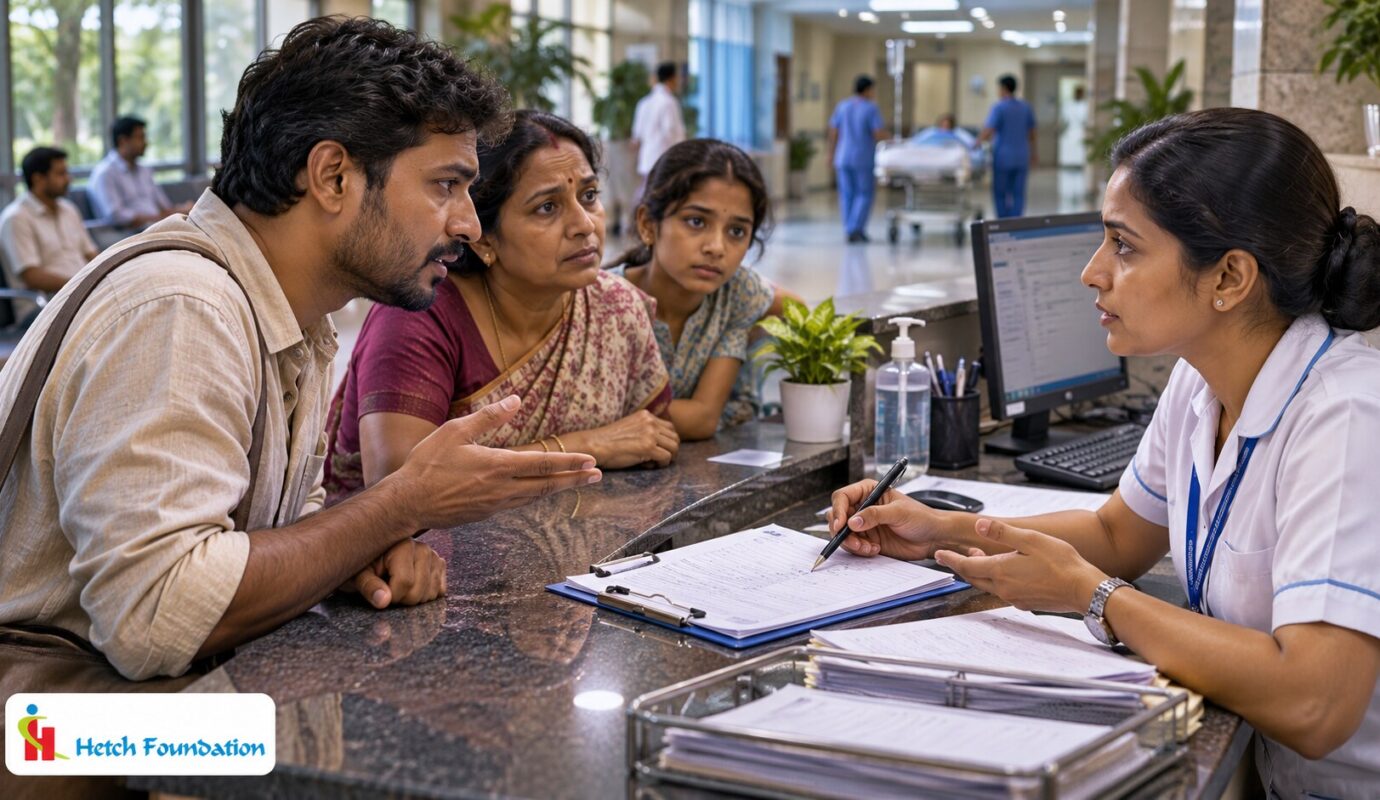
A family reaches the hospital after receiving a call about a road crash. One person goes to find the emergency team. Another wants to know whether the hospital can arrange cashless treatment. Someone else has the crash location but does not know which police team is handling the report. The questions are different, and it helps to understand which ones the clinical team, the hospital desk and the police can answer.
PM-RAHAT stands for Prime Minister – Road Accident Victims’ Hospitalisation and Assured Treatment. It is India’s nationwide cashless treatment scheme for eligible victims of road crashes caused by the use of motor vehicles. The scheme is meant to support prompt access to hospital care. If you are at the crash scene, the first task is to call for emergency help. The administrative questions can be handled alongside care once the responders and hospital are involved.
What the scheme covers
The scheme provides cashless treatment cover of up to ₹1.5 lakh per victim, subject to a maximum of seven days from the date of the crash. It applies to eligible crashes on any category of road. That matters to families who may assume the programme only applies to National Highways. Coverage is available at designated hospitals under the scheme and treatment is processed through the applicable health benefit packages. The figures describe the scheme’s limits. Ask the treating hospital which services are being registered under it in your case.
Think of the date and the amount as two separate limits. If the crash happened yesterday and a family member arrived today, the seven-day period is still measured from the date of the crash. A person whose treatment continues beyond the period, whose costs exceed the cap, or whose care includes services outside the applicable packages may need to discuss other arrangements. Ask for that explanation while there is time to understand it with the treating and administrative teams.
Cashless treatment under PM-RAHAT is a way for covered care to be processed by the participating hospital. The ceiling is not a payment handed to a family. The approach also differs from asking whether an individual motor insurance policy can pay. The scheme is available to eligible victims irrespective of insurance status. Hospital staff can explain how the treatment record and the incident details are being processed.
Getting to care and starting the hospital process
When someone needs urgent help after a crash in India, call 112 from a safe place. Give the road, direction, location and what you know about the injuries or hazards. The emergency system can help with ambulance assistance and provide information about the nearest designated hospital. Follow the operator’s directions. If a patient is already at a hospital, tell staff they were injured in a road crash involving a motor vehicle and share the approximate location and time if known.
Ask whether the facility is designated under PM-RAHAT and which person or desk handles the scheme. A hospital may start eligible treatment while police authentication is initiated in parallel. The hospital uses its treatment system, and police use the accident reporting system to verify details. Ask who will follow up on missing information and whether there is a case or treatment identifier you should keep. Use any reference only with the appropriate parties.
If the patient is already at a facility and a transfer is being discussed, ask the treating team which destination can provide the required care and how a safe transfer can be arranged. The nearest designated facility and the facility equipped for the patient’s particular injuries may need to be considered together. Let the clinical team guide the timing and transport arrangements. Keep someone available to share the location, patient details and any records needed for that handover.
Questions to ask at the hospital desk
Ask whether the patient has been registered under PM-RAHAT. If the record is still being set up, ask what information is missing and who is responsible for obtaining it. Confirm how the hospital is communicating with the police and how the family can identify the record if staff change shifts. Write down the name or role of the person you spoke with and the time of the conversation. A short written note helps relatives avoid repeating the same questions or relying on incomplete messages.
Ask which treatment packages the hospital is applying and whether it expects any items or later care to fall outside the scheme. Ask for an explanation in plain language if a bill or deposit request is unclear. You can ask which part relates to covered treatment, which part is being handled separately and where you can clarify a disputed item. Preserve any estimate, receipt or written response you are given. Keep clinical discussions with the treating team so an administrative question does not distract from urgent decisions about care.
If the family is still finding out what happened, share what is known and mark estimates clearly. A useful description might identify the direction of travel, the nearby landmark and the time the patient arrived. There is no need to guess how the crash occurred. A relative can coordinate these details while others focus on the patient. For a specific dispute about eligibility or documentation, ask the hospital to identify the appropriate scheme contact or grievance channel.
Two questions families often ask
Does this apply if the crash happened on a local road?
The national scheme can apply on any category of road where the crash was caused by use of a motor vehicle. Give the hospital the location and incident details and ask about the designation and registration process. The eligibility check is tied to the case, even when the road is a small municipal street.
What happens if the patient needs treatment for longer than seven days?
Ask the treating team what care remains necessary and ask the hospital desk which parts fall within the scheme’s period and cap. Follow up early about any other support or payment arrangements that may be available. Treatment decisions should be guided by the patient’s clinical needs, while families get a clear explanation of how each part of the care is being recorded and funded.
If a crash happens, reach emergency help first. At the hospital, ask whether the facility is designated, whether the case has been registered and who can explain which treatment is covered. Those three questions give the family a clear starting point in a difficult conversation.