


Stopping Distance Explained: How Speed and Distraction Steal Your Space
The brake pedal is not the beginning of a stop. By the time your foot reaches it, the vehicle has already travelled while you noticed a problem, understood it and decided how to respond. That overlooked stretch of road is where an apparently manageable situation can become frighteningly close.
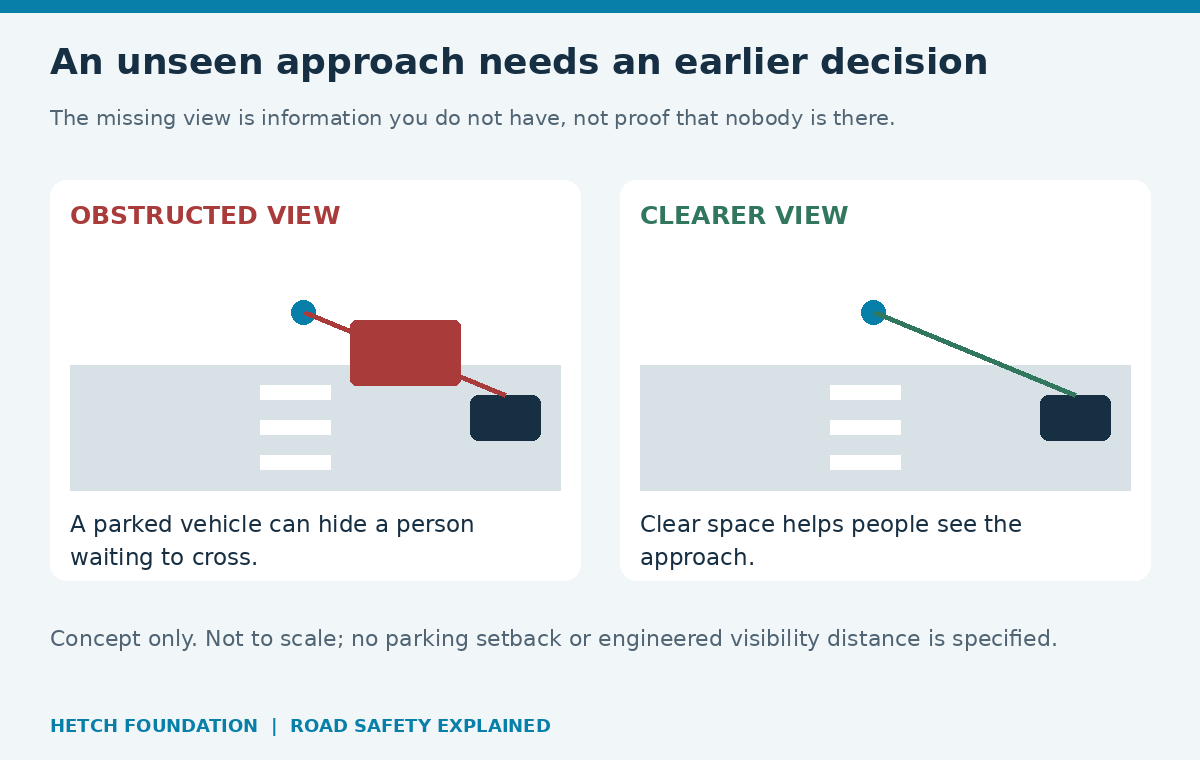
Picture a familiar journey to the shops. A van is parked near a crossing. Your phone lights up, you glance down, and when you look back a person is waiting where the van had hidden the pavement. Nothing about the car has failed. What has changed is the space and time left to make a decision.
Understanding stopping distance helps explain why careful driving needs more than confidence in the brakes. It also gives families, passengers and employers a better way to discuss speed and distraction without turning every conversation into a lecture.
What is stopping distance?
Stopping distance is the distance travelled from recognising a need to stop until the vehicle comes to rest. It combines two parts: movement during the driver’s response, often called thinking or reaction distance, and movement while the brakes slow the vehicle, called braking distance. These are useful categories, not two perfectly separate moments you will feel during an emergency.
The first part depends on how quickly the situation becomes clear and how the driver responds. The second depends on speed, grip, vehicle condition and other circumstances. A single distance quoted without its assumptions cannot describe every car, road surface or driver.

How far does the vehicle travel while you look away?
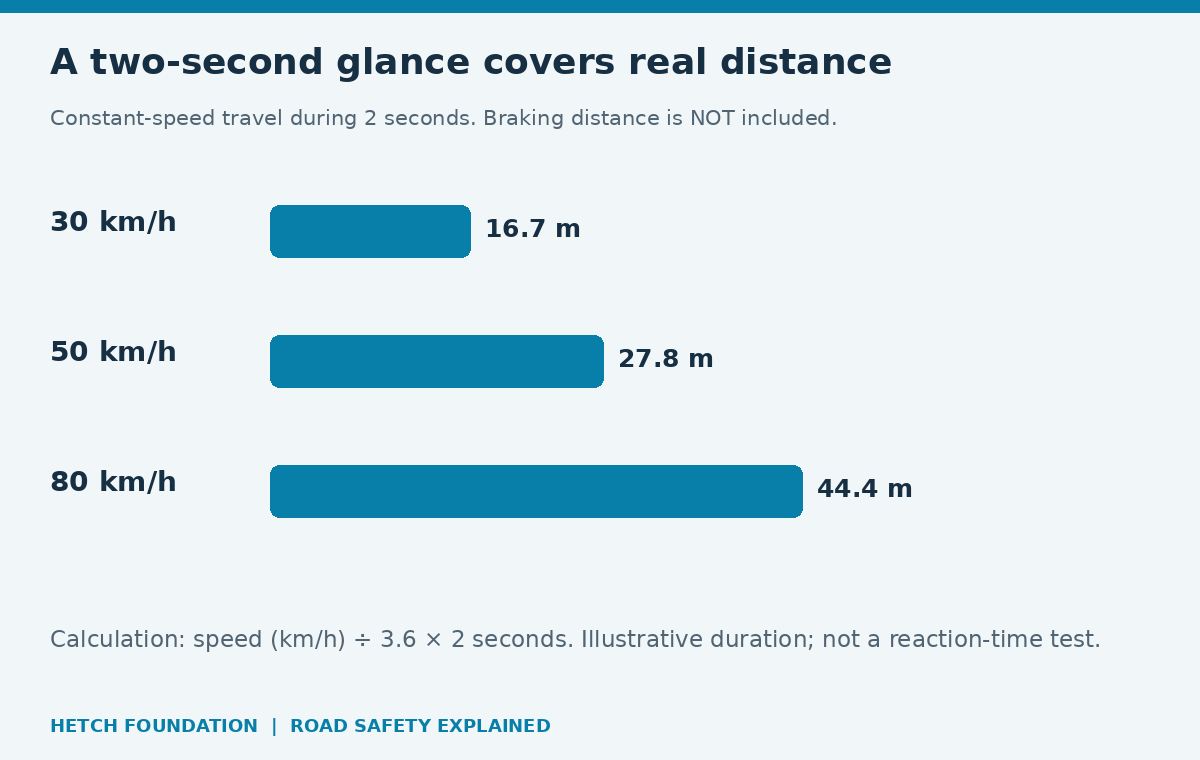
Here is a calculation rather than a crash prediction. At a constant 50 km/h, a vehicle covers approximately 13.9 metres each second. During a two-second glance away, it travels about 27.8 metres. At 80 km/h, the same two seconds cover about 44.4 metres. Neither figure includes the distance required to brake afterwards.
The calculation is speed divided by 3.6 to convert kilometres per hour to metres per second, multiplied by elapsed time. It assumes constant speed. Two seconds is an illustrative duration, not an estimate of every person’s reaction time or every phone interaction.
Why make this distinction? Because a colourful graphic can easily create false reassurance. A bar showing 27.8 metres does not mean a driver will stop within that distance. It shows how much road passes beneath the vehicle before we even consider the braking that may still be needed.
Why good brakes cannot recover a missed observation
A well-maintained vehicle matters. But the brakes cannot react to something the driver has not yet noticed. The World Health Organization identifies mobile-phone use as a distraction that affects reaction, lane keeping and following distance. Its guidance also warns that hands-free calls do not remove the risk associated with phone conversations.
Think about an ordinary instruction from a passenger: “Turn here.” If it comes too late, the useful response is to continue to a suitable lawful route, not make the car obey the original plan at any cost. The same principle applies to the phone. A late observation should lead to a safer next decision, not a sudden correction made to recover lost time.
Before departure, prepare navigation, settle loose belongings and arrange how calls will be handled. If information needs your attention, deal with it only after parking safely and lawfully. Being paused at a red signal is not the same thing as ending the driving task.
The speed limit is a ceiling, not a promise
A number on a sign cannot tell you whether a pedestrian is behind a parked vehicle or whether rain has left a slippery patch beyond a bend. Stay within the applicable limit and choose a lower speed when the actual conditions require it.
As a general safety principle, the UK Highway Code advises drivers to be able to stop within the visible clear distance. That is useful explanatory guidance; it is not being presented here as an Indian legal rule. Local signs, Indian traffic law and lawful directions still govern the journey.
A familiar street can deserve extra caution precisely because you know its limitations. If the bus stop regularly hides people or a gate opens directly onto the road, let that knowledge change your approach early. Do not rely on the absence of a problem yesterday.
Rain changes the margin you need
A wet road is not simply a dry road with reduced visibility. Grip may change too. The UK Highway Code warns that wet-weather stopping distances can be at least twice those needed in dry conditions. That is a warning to increase the margin, not a personalised formula for your vehicle.
Slow earlier, leave more room and avoid abrupt demands on steering and braking. Have tyres, brakes and other concerns checked appropriately. Do not experiment with emergency braking on a public road to find out what your car can do. Practical vehicle-control training belongs in a suitable supervised setting.
What does a useful following gap achieve?
The gap ahead is working space. It allows a developing situation to become visible and gives you options besides a hard stop. When someone enters that gap, avoid treating the movement as an insult. Re-establish space smoothly rather than accelerating toward their rear bumper.
Distance behind a large vehicle also affects what you can see. Sitting close to a bus may hide the crossing or queue beyond it. A larger view can make the next decision less hurried. It is not a guarantee against another person’s mistake, but it reduces your dependence on guessing what lies ahead.
What passengers and workplaces can change
A family member who demands an instant reply can undermine the phone-free journey they say they want. Agree beforehand that messages will wait. Give navigation instructions early, and accept a missed turn without asking for an immediate manoeuvre.
Employers can apply the same standard to work calls and arrival estimates. If a meeting finishes late, adjust the next appointment rather than expecting the driver to recover the delay on the road. A safety policy becomes credible when the schedule supports it.
Questions drivers often ask
Does ABS mean I can follow more closely?
No. Anti-lock braking is not permission to reduce space. The vehicle handbook explains operation of the fitted system. Whatever technology is present, attention and an appropriate margin remain part of driving.
Is a short phone glance harmless at low speed?
Low speed does not make nearby people disappear. A car park or neighbourhood entrance may contain pedestrians close to the vehicle. Prepare the device before moving and park appropriately before using it.
Can I use the distance chart as a stopping guide?
No. It calculates travel during a stated time at constant speed. It excludes braking distance, road grip and individual response. Its purpose is to make the cost of unavailable attention visible.
A preparation check for the next journey
- Set navigation and put the phone away before movement.
- Look beyond the vehicle immediately ahead.
- Choose speed for visibility and conditions within the legal limit.
- Allow more room when grip or visibility deteriorates.
- Let a missed turn remain a route problem.
The aim is not to become anxious about every metre. It is to stop spending the same space twice: first on speed or distraction, and then assuming it is still available when something unexpected appears.
Sources and calculation notes
Research checked 14 November 2026. Sources: WHO road traffic injuries guidance; WHO report on mobile-phone distraction; UK Highway Code rules 120, 125 and 126 and wet-weather guidance. The distance graphic is an original calculation, not a measured stopping-distance test.
About the book
HarGhar Se EkSainik by Syed Abdul Hakeem asks readers to connect everyday road choices with the lives around them. This independently written explainer develops that purpose through practical evidence and original visuals. Continue with The Road We Share article collection from Hetch Foundation.