


Truck Blind Spots: Why the Gap Beside a Turning Vehicle Can Disappear
At a junction, a truck moves slightly away from the kerb. A rider sees an opening alongside it. For a moment, the space looks useful: enough room to move ahead of the queue. Then the truck begins turning, and the opening starts to close.
This is not a story about a particular crash. It is an illustrative situation that shows why the shape of a gap can be misleading. The space visible right now may be part of the movement a large vehicle is about to make.
Truck blind spots and turning paths deserve a closer explanation because advice to “be careful around trucks” leaves too much unsaid. What should a rider notice? What must the truck driver check? And what can a business change before either person reaches that junction?
For scale, MoRTH’s Road Accidents in India 2023 reports that two-wheeler users accounted for 44.8% of reported road deaths that year. That figure covers all relevant road crashes; it does not mean that trucks or blind spots caused that share. It explains why rider protection deserves attention without claiming a cause the data does not establish.
What is a truck blind spot?
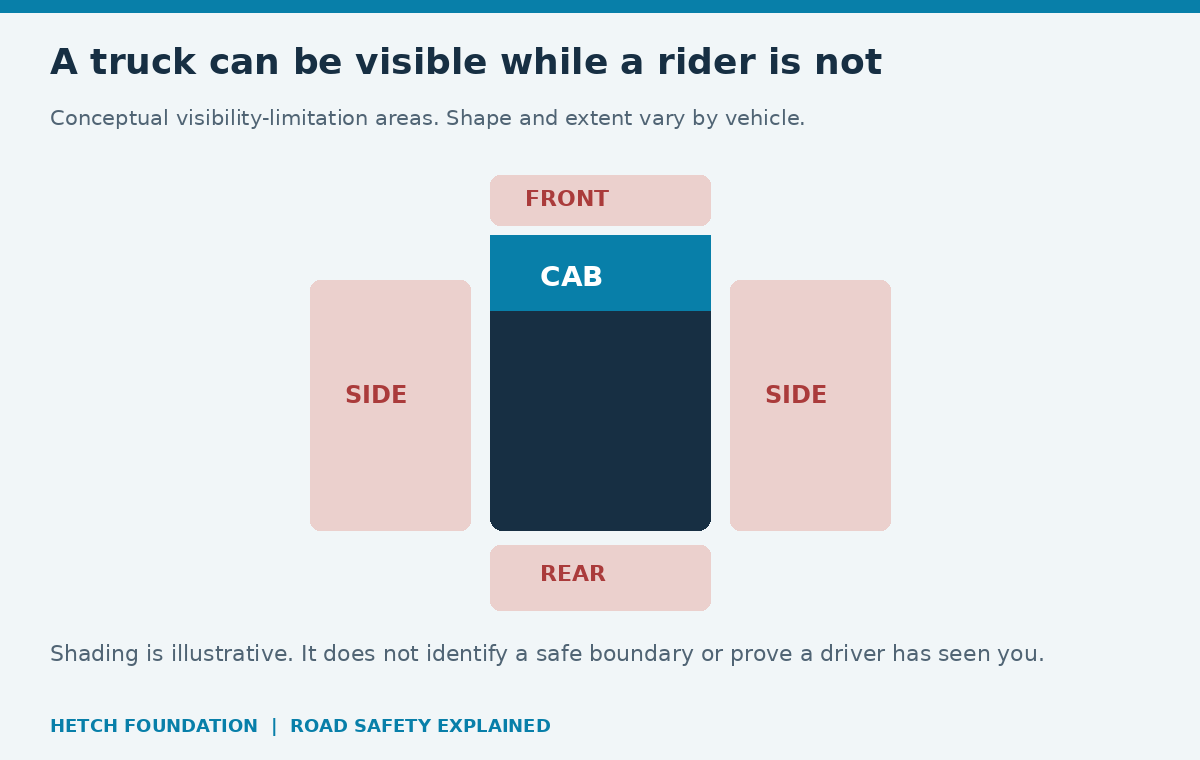
A blind spot is an area a driver cannot adequately see from their driving position through the available direct view and mirrors. It is not a fixed painted box around every truck. Its location and extent depend on cab design, mirror adjustment, vehicle configuration and the positions of other people.
The US Federal Motor Carrier Safety Administration identifies limited visibility around the front, rear and sides of large vehicles. Its guidance is useful for understanding the physical problem. Direction-specific examples on US roads must not simply be copied into Indian left-hand traffic.
A rider can see a large truck easily while remaining difficult for its driver to see. Visibility is not reciprocal. Being able to see the vehicle’s body tells you little about the driver’s view of your position.
Why seeing a mirror is not a guarantee
A common reminder says that if you cannot see the truck driver in the mirror, assume the driver cannot see you. Treat that as a caution, not a test that establishes safety. Seeing a mirror or a driver’s face does not prove that the driver has noticed you, understood your intention or will continue on the same path.
Do not ride close to a truck to perform the test. Maintain room and follow the applicable rules. Signals, eye contact and a horn can communicate something, but none should be used as permission to occupy a space that may disappear.
Imagine the difference between being visible and being accounted for. A person may appear in a mirror briefly while the driver checks another part of a complicated junction. A safer plan leaves room even if that brief appearance was missed.
What happens when a large vehicle turns?
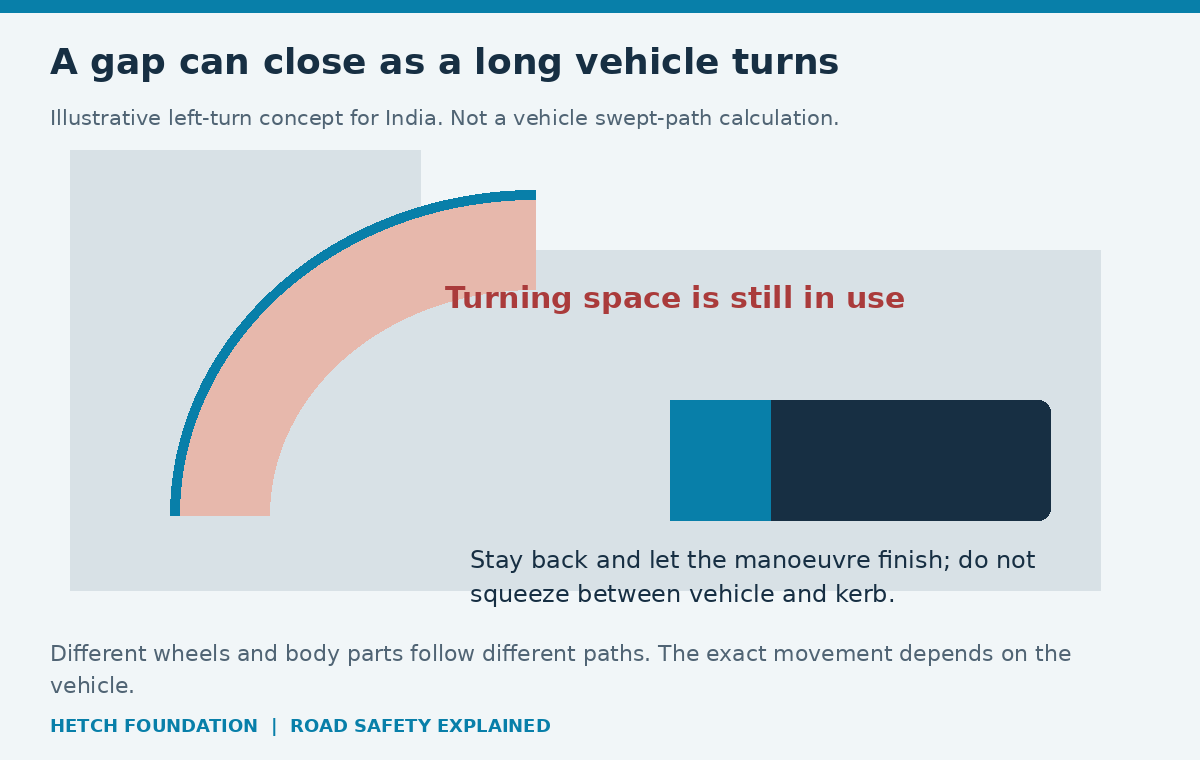
Different parts of a long vehicle do not all trace the same line through a turn. The rear wheels may track inside the path of the front wheels. Other parts of the body can sweep through adjacent space. The details vary with vehicle type and manoeuvre, which is why this article’s drawings are conceptual rather than clearance measurements.
The practical consequence is simple: do not assume a narrow strip beside a turning vehicle will remain open. At an Indian junction, particular care is needed around the kerbside of a left-turning large vehicle. Danger can also arise on the other side, in a right turn, or from body swing. One familiar example must not become a claim that every other position is safe.
Riders: let the turn finish
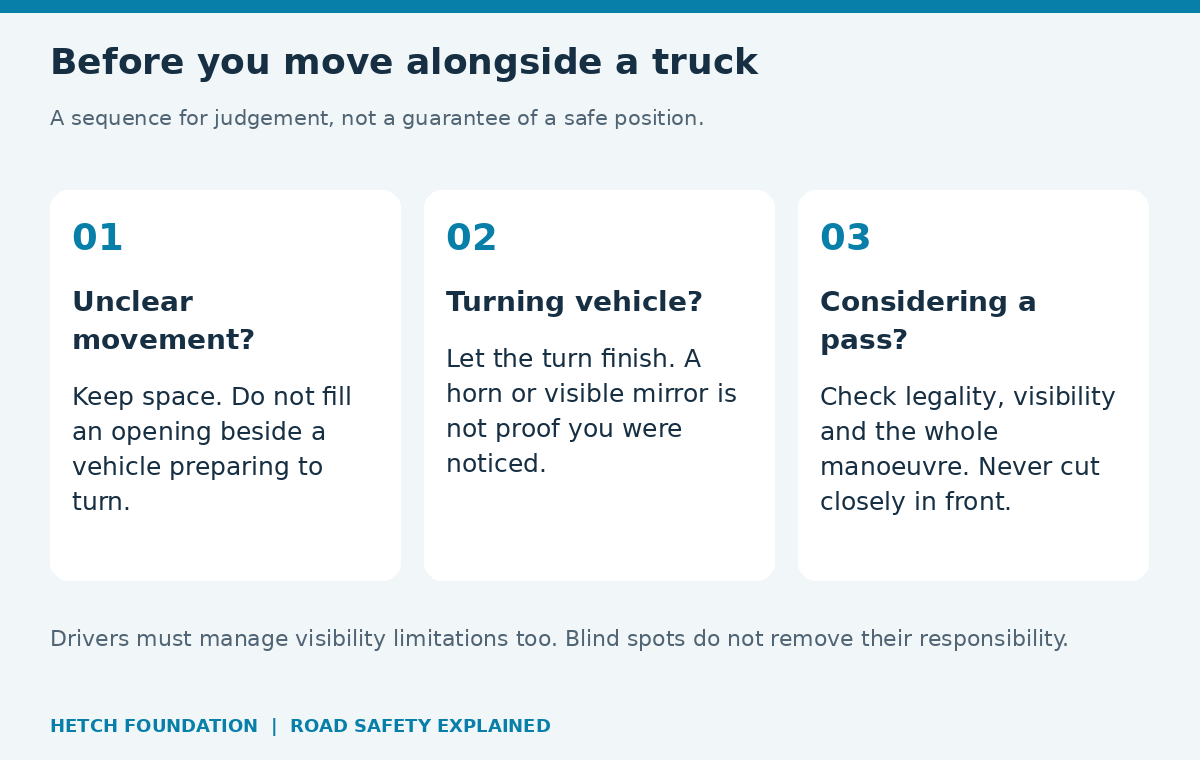
If a large vehicle is turning, indicating a turn or positioned in a way that makes its next movement uncertain, avoid squeezing alongside to gain a few metres. Stay back with room to observe. Do not stop immediately against the front of the cab, where the driver may have a limited view.
If you are already beside a truck, avoid abrupt swerves or racing to beat it. Respond to the traffic actually around you and move toward a position with space only when safe and lawful. An article cannot supply a universal escape manoeuvre for every moving situation.
Before overtaking, assess the entire movement, including the space needed afterwards. India’s Motor Vehicles (Driving) Regulations, 2017 prohibit overtaking in specified situations, including junctions and pedestrian crossings. Do not interpret advice to avoid lingering beside a truck as an instruction to accelerate past at a junction.
Why cutting in front creates a second problem
Moving out of a side blind spot does not justify cutting closely into the truck’s path. Heavy vehicles have different stopping characteristics from smaller vehicles. A driver may see a person ahead and still lack sufficient distance to stop without a conflict.
A useful passing decision considers what happens after the pass. Is there a clear, lawful place to complete it without demanding sudden braking from anyone? If a queue is only a short distance ahead, the manoeuvre may offer little benefit while introducing another decision for both drivers.
There is no single number of metres in this article that makes every pass safe. Speed, road layout, load, visibility and conditions matter. Leave generous room rather than treating a diagram as a boundary you can ride along.
Truck drivers have an active responsibility
Blind spots describe a limitation to manage, not an excuse to stop looking. Drivers need correctly adjusted and serviceable mirrors, clear windows, appropriate checks and an unhurried assessment before moving. Any fitted camera or detection aid must be used according to its instructions; technology does not remove the observation task.
Indicate intentions in good time and reassess before a turn, especially when traffic has been filtering or people may have approached the vehicle. If the movement cannot be completed safely, wait rather than relying on others to understand an unusual line.
Where a manoeuvre requires an authorised trained banksman or site procedure, use it. Do not ask an untrained passer-by to stand in moving traffic and improvise control. A delivery deadline cannot make an unsuitable unloading location workable.
What transport operators and delivery sites can change
Ask where a truck must turn, reverse and stop before booking a delivery. A narrow entrance approached during the busiest pedestrian period can create predictable difficulty. Adjusting the schedule or arranging an appropriate unloading location may remove the recurring conflict more effectively than another warning poster.
Drivers should be able to report unsuitable access without being criticised for delay. Maintenance teams should have a clear way to resolve damaged mirrors or visibility equipment. Record a concern, name who will act and check the result before the next comparable movement.
For a workplace discussion, use an unloaded stationary vehicle in a properly controlled area with a competent instructor. Do not create a demonstration beside live traffic. The purpose is to understand limitations, not discover how close people can stand.
Questions riders often ask
Is the left side always the dangerous side?
No. The danger depends on the movement and vehicle. This Indian example highlights a kerbside left-turn conflict, but blind spots and sweeping movements can affect other areas. Avoid treating any side as automatically protected.
Does a turn indicator guarantee the truck will turn?
No signal removes the need to observe. It is information to consider alongside position and traffic. Keep space when intentions are uncertain rather than making an optimistic guess.
Should I sound the horn and pass?
A horn does not establish that you have been seen or make an unsafe pass acceptable. Wait for a clearly safe, lawful opportunity. Do not use another person’s reaction as the margin your plan depends on.
A better question than “Will I fit?”
Ask whether the space will remain available throughout the manoeuvre. That changes the decision from measuring an opening to understanding a movement. Sometimes the best answer is to remain behind and let the junction clear.
For more on the human judgement behind overtaking, read A Safe Overtake Begins With Respect for the Person Ahead.
Sources and scope
Research checked 14 November 2026. Indian road-user figures: MoRTH, Road Accidents in India 2023. Sources: FMCSA guidance for people driving near trucks, truck and bus drivers and cyclists and pedestrians; India’s Motor Vehicles (Driving) Regulations, 2017. Additional physical-manoeuvre guidance: UK vocational driving examiner guidance and National Highways large-vehicle guidance. Overseas road-position examples have been adapted cautiously; Indian law and local controls apply. Original diagrams show concepts, not measured visibility zones.
About the book
HarGhar Se EkSainik by Syed Abdul Hakeem encourages consideration for every person sharing a road. This original explainer connects that purpose with vehicle limitations and workable decisions. Explore Hetch Foundation’s Chapter 2 collection for the lives and homes behind those journeys.