


Rear Seat Belt Safety: Why Airbags and a Short Trip Are Not Enough
You open the back door of a taxi, sit down and find the buckle buried under a seat cover. The driver says the journey is short. You have already put your bag down and the car is about to move. Asking everyone to wait feels awkward.
That small social pressure helps explain why a safety decision can disappear from the back seat. Nobody has announced that restraints do not matter. The arrangement simply makes wearing one harder than leaving it unused.
Rear seat belt safety needs a practical discussion: what the belt does, how to wear it, what airbags cannot replace and how passengers and operators can make the safe choice ordinary. The guidance here concerns adults. Children need restraints selected and installed for their size and the vehicle, rather than an adult-belt shortcut.
Why the back seat still needs a belt
When a vehicle slows abruptly, an unrestrained occupant’s body continues moving until something else changes that movement. That something may be the vehicle interior or another occupant. Sitting farther from the windscreen does not remove the motion.
A correctly used restraint helps manage the occupant’s movement. It is part of the protection provided by the vehicle, not a decoration intended only for the front row. NHTSA advises adults to buckle up on every trip, including in rear seats and for-hire vehicles.
The drawing below is deliberately simple. It explains relative movement rather than predicting a particular crash or showing how every vehicle’s restraint system works. Real outcomes depend on many interacting factors, including crash direction and severity.

How should an adult three-point seat belt fit?
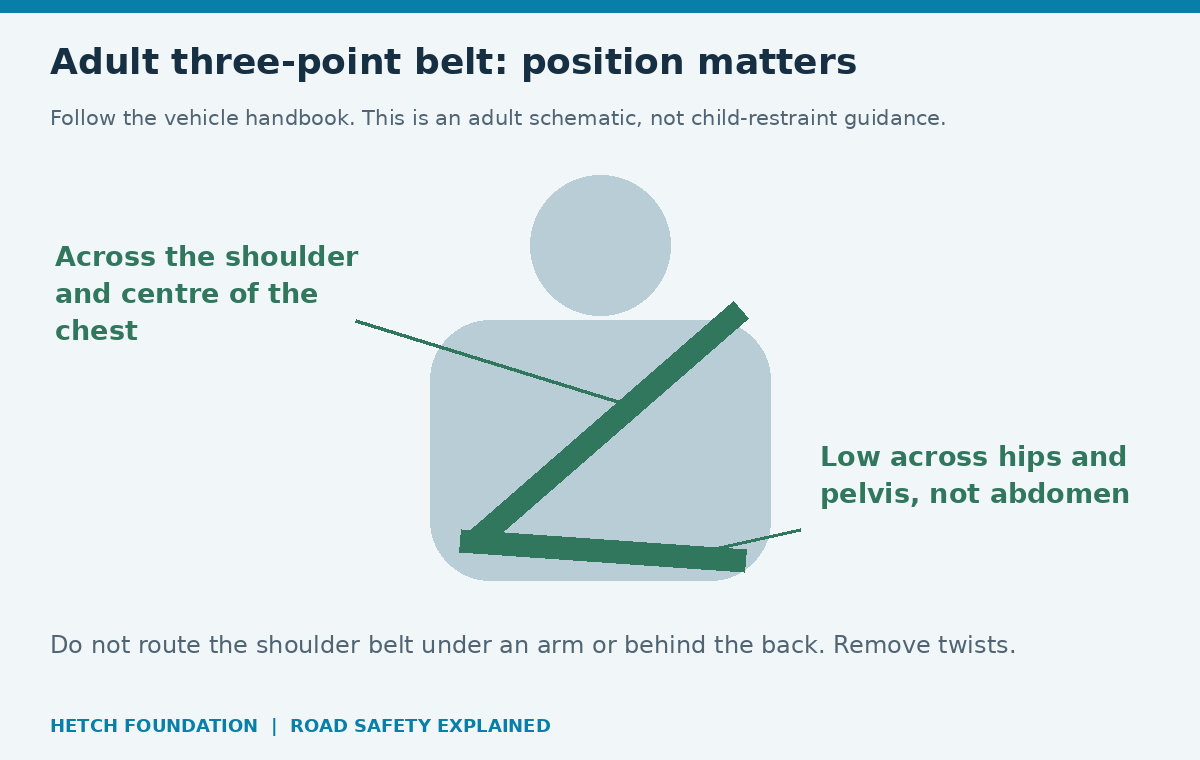
The lap portion should lie low across the hips and pelvis, not across the abdomen. The shoulder portion should cross the middle of the chest and rest appropriately across the shoulder. Keep it out from under the arm and do not place it behind the back.
Sit upright against the seat and remove twists. Use the belt for the seating position you occupy, fastening it to the correct buckle. Follow the vehicle handbook and any manufacturer instructions for adjustments. If the belt does not fit or function correctly, resolve the issue before travelling rather than improvising with a clip or sharing a belt.
Check the arrangement after settling a coat or moving a bag. The action is small enough to become automatic, but it still deserves a real glance. Hearing a click is useful only when the correct belt is correctly positioned.
Airbags work with belts
NHTSA describes airbags as supplemental protection designed to work with seat belts. They do not turn an unrestrained passenger into a protected one. Equipment also varies: an airbag in one part of a vehicle does not mean the same protection exists at every seat.
A vehicle’s feature list can encourage the wrong question: “How many airbags does it have?” Ask another one alongside it: “Am I seated and restrained as the manufacturer intends?” Both vehicle design and actual use matter.
Avoid treating advanced features as permission to neglect a basic preparation step. The safety equipment was not designed around a passenger deciding which part of the system to leave unused. Read the handbook for the vehicle you actually travel in.
The short-trip argument does not solve the problem
“Only five minutes” describes the intended duration, not every movement that will occur during it. A short journey still includes junctions, braking, other vehicles and decisions outside your control. The inconvenience of fastening a belt also does not grow shorter in a useful way when you compare it with the length of the route.
It is more practical to remove the debate. Sit, fasten, check, then move. If the household standard changes with distance, every departure invites a fresh negotiation. A consistent routine asks less effort from everyone.
A passenger can make the request without a speech: “Please wait while I put my belt on.” A driver can respond by waiting. This is not a challenge to anyone’s competence. A restraint is used because a road journey cannot be reduced to confidence in one person.
What to check before a taxi or ride-hailing journey
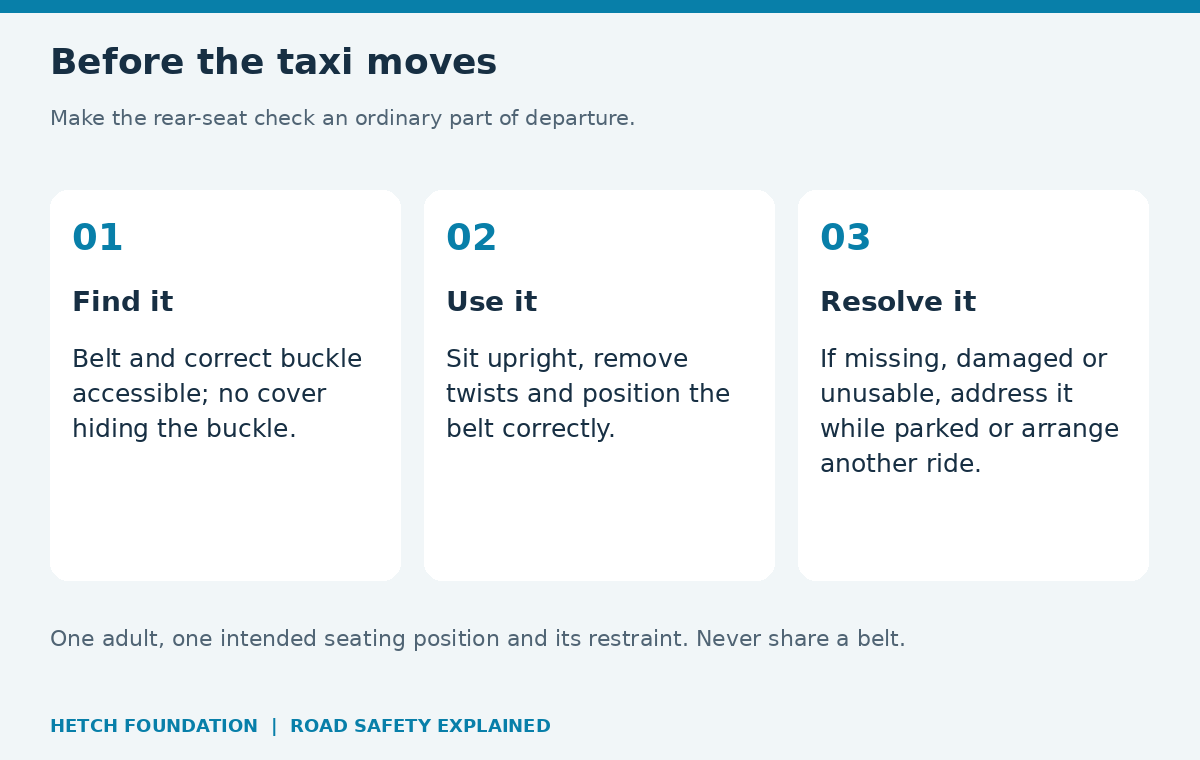
Look for the belt and buckle before the vehicle pulls away. They should be accessible without dismantling a seat or reaching into an unsafe position. If a cover hides the buckle, ask for the problem to be resolved while the vehicle remains parked.
Do not accept a loose belt tongue as evidence that the whole restraint is usable. Check that the appropriate belt can be fastened and worn correctly. If a belt is missing, damaged, cannot latch or cannot be used properly, request an appropriate alternative. Use the service’s support process for an unresolved concern.
Avoid arguing while moving. If the journey has already started and a problem becomes apparent, ask the driver to stop at a safe, lawful place so it can be addressed. Do not unfasten or change seats in a moving vehicle to demonstrate a fault.
Drivers and operators can remove the friction
Make restraint access part of the vehicle check, including the back row. A beautifully fitted seat cover is not useful if it hides the buckle. Ask passengers to fasten before departure and allow the time they need, including people who move more slowly.
Operators should have a straightforward process for reporting a faulty belt and taking the vehicle out of passenger use until the issue is appropriately resolved. A driver should not have to choose between a trip target and reporting equipment that needs attention.
For fleet managers, check the routine through ordinary observation: can an adult sit down, find the buckle and use the belt without help? If not, the next action should address the equipment or arrangement, not simply tell passengers to be more responsible.
Families can make the back-seat standard visible
Adults sometimes enforce a preparation rule for others while exempting themselves. The rear seat offers an easy place to correct that mismatch. Fasten your own belt and let the driver know when you are ready.
If someone forgets, use a specific reminder rather than embarrassing them. “Your buckle is beside your right hip” is more useful than a running argument about their attitude. If help is needed, ask before touching or reaching across their body.
The same care applies when arranging travel for an older relative. Allow time, choose an appropriate vehicle and listen to any difficulty with access. Independence and safe preparation can be supported together.
Common questions about rear seat belts
Can I put the shoulder belt behind me if it feels uncomfortable?
No. That changes how the belt is intended to work. Check seating position and the permitted adjustment, following the vehicle instructions. Do not solve discomfort by misrouting the belt.
Can two adults share a single belt?
No. Use the restraint intended for each seating position. If the vehicle cannot accommodate the passengers properly, change the arrangement before departure.
Does sitting in the middle remove the need for a belt?
No. Use the restraint provided for that seating position according to the handbook. Do not choose a position merely because someone says it is safe without protection.
Is an adult seat belt enough for any child?
No. An adult-focused illustration should not be copied onto a child. Use an appropriate child restraint and follow its instructions, vehicle compatibility requirements and applicable local rules.
Make the pause part of the journey
A belt check should feel as ordinary as closing the door. It is easier to sustain when the driver expects it, the equipment permits it and nobody turns the brief wait into an inconvenience. Before the next trip, make sure the back seat offers a usable restraint, then use it.
Read also A Passenger’s Gentle Reminder Can Change the Whole Journey.
Sources and scope
Research checked 14 November 2026. Sources: NHTSA’s adult and rear-seat belt guidance and airbag guidance. These explain safety principles, not Indian penalties. Follow the vehicle and restraint manufacturers’ instructions and applicable local requirements. Diagrams are original adult-focused explanations.
About the book
HarGhar Se EkSainik by Syed Abdul Hakeem connects care at home with the habits taken onto the road. This original Hetch Foundation guide develops that idea into practical passenger preparation. Explore the Chapter 2 collection for more on the people behind every journey.