

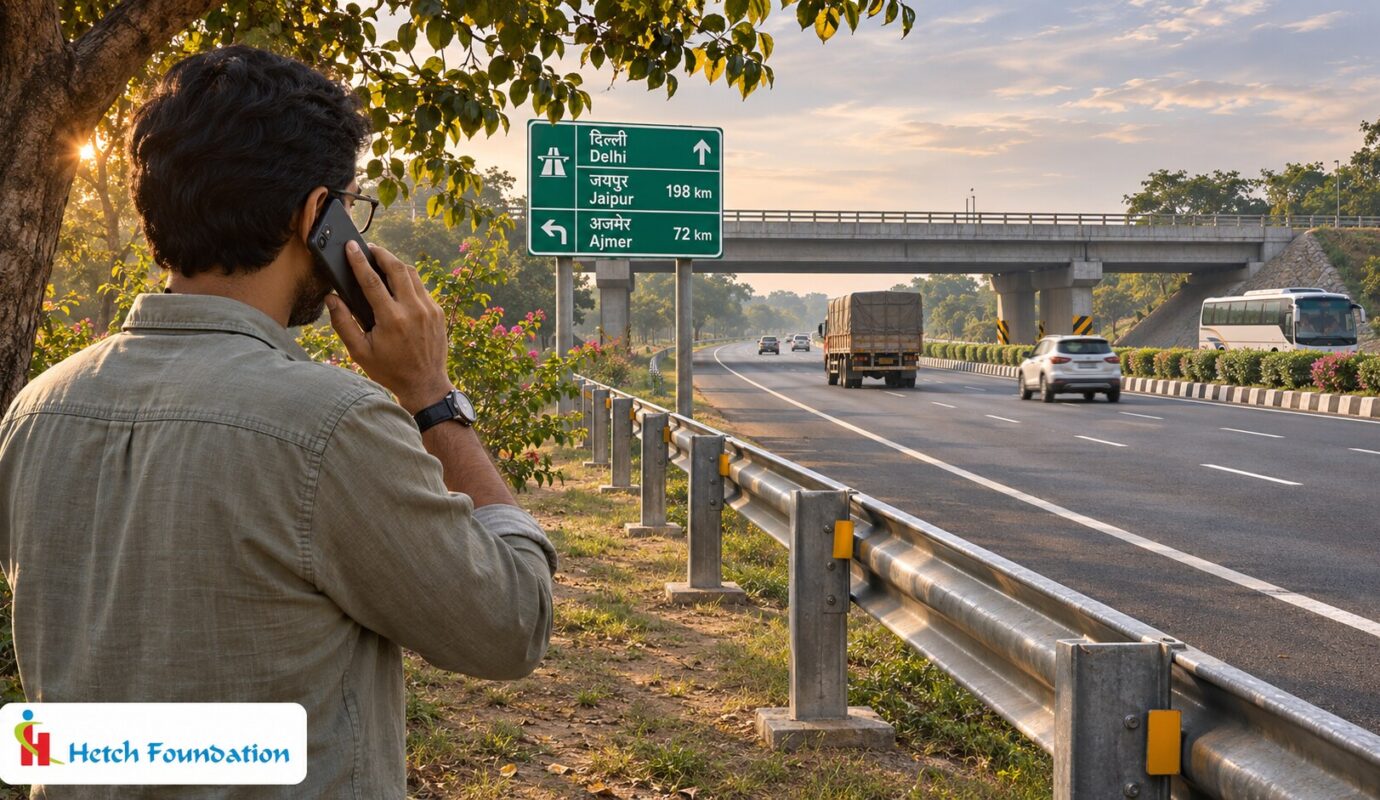
What to Say When You Call 112 After a Crash
By Hetch Foundation
You hear a sudden impact near a junction. By the time you reach a safe place to stop, several people are looking towards two vehicles in the road. Someone asks whether help is coming. A shop sign is visible across the street, but you have no idea what the road is called. What you can tell an emergency call handler from where you are standing is already useful.
In India, 112 is the nationwide emergency number. After a road crash with injuries, a trapped person or an immediate danger, call from a safe place. Give the location as clearly as you can, then explain what happened, who may need help and what hazards are present. The call handler can ask follow-up questions. You can start the call while the street name or exact number of people involved is still unknown.
Make the call from a safe position
Watch the traffic around you before you do anything else. If you are driving, find a place to pull over safely and lawfully before using the phone, or ask a passenger to call while you keep driving safely. If you are on foot, remain on the footpath or another safe area away from moving vehicles. A better view of the wreckage is rarely worth stepping into a lane or crossing fast-moving traffic.
At a busy scene, look at a specific person and ask them to call if you cannot. A direct request like “You in the blue shirt, please call 112 and tell me when you are connected” is easier to act on than a general shout. If someone has already made contact, offer to read a sign or confirm the direction of travel from where you can safely stand. Relay any important change to the person already speaking with the call handler.
Give the road, the direction and one useful landmark
Start with the town or area if you know it. Then identify the street, highway or junction, followed by the side or direction of travel. “On the Hyderabad-bound side, just after the flyover” gives responders a much better starting point than “near the flyover.” On divided roads, the direction matters because a vehicle sent to the opposite carriageway may have to travel farther to turn around. Use familiar destinations to explain direction if you are unsure which way is north or south.
Pick a landmark responders can identify quickly. A metro station entrance, named junction, toll plaza, petrol pump or kilometre marker is often easier to find than a small shop. If several places have the same name, give one extra detail such as a station gate number, the name of the intersecting road or the nearest exit. Mention whether the crash is on a flyover or below it, or on a service road beside the highway. Two points can look very close on a map while requiring different approaches by road.
If you have a map open, check whether the pin shows the crash or simply your position. Tell the call handler if you are calling from across the road or from a nearby building. Offer the coordinates or location information if requested and read it back carefully. A map can help confirm a description you already gave. In places with weak connectivity, the sign you passed or the village you just left may be the best clue you can give immediately.
Describe what you can see
Say “road crash” at the start. Use short, concrete descriptions. How many vehicles are involved? How many people can you see who may need help? Is someone unable to get out of a vehicle? Is a lane blocked? Mention smoke, fire, a suspected fuel spill or any other immediate danger you can see from a safe position. If traffic is still moving past the scene, say which part of the road is obstructed.
Use estimates openly. “I can see two people who may be injured, and there could be others inside the car” gives a more useful picture than a guess stated as a confirmed count. If a person is already getting help, say what you can see without assuming the helper is a clinician. Answer the operator’s questions as best you can and follow their instructions. Tell them if a requested action would require you to step into moving traffic or another hazard.
A worked example for a divided road
Here is how a caller might begin. “There has been a road crash. I am near the eastern end of the flyover, on the service road in the direction towards the city centre. The crash is just past the petrol pump on this side. A scooter and a car are involved. I can see one person lying near the kerb and traffic is still moving in the next lane. I am calling from the footpath outside the petrol pump.”
The operator may ask about the road name, possible injuries or how responders can reach you. Give a callback number if asked. If your signal drops before you know whether the report went through, try again from a safe location and explain that the earlier call disconnected. If you are directed to stay available, keep your phone accessible for a callback. Tell the operator if the scene changes substantially, such as a fire starting or a route becoming blocked.
Two questions people often ask
What if someone says they have already called?
Ask whether the call connected and whether the operator received the location and direction. If those details have been passed on, you can help by being ready to relay new information through the caller. If no one can confirm that the report got through and help is still needed, make the call yourself. Say that you may be reporting an incident someone else has already called about.
What if I was in a moving vehicle and have already passed the crash?
Ask a passenger to call, or pull over safely before making the call yourself. Say where you were when you saw the crash, the direction you were travelling and the last reliable landmark you passed. Explain how far you are from the scene now, if you know. If you only saw it briefly, say so. A clear account of what you saw helps the call handler judge the information they receive.
On your next regular trip, notice one landmark you could use to explain your position in an emergency. On a highway, look for places where the main road, service road and flyover run close together. Practise saying the location aloud while safely parked. If the day comes when you have to call, begin with the words you already know: what happened, where it happened and what help is needed.