

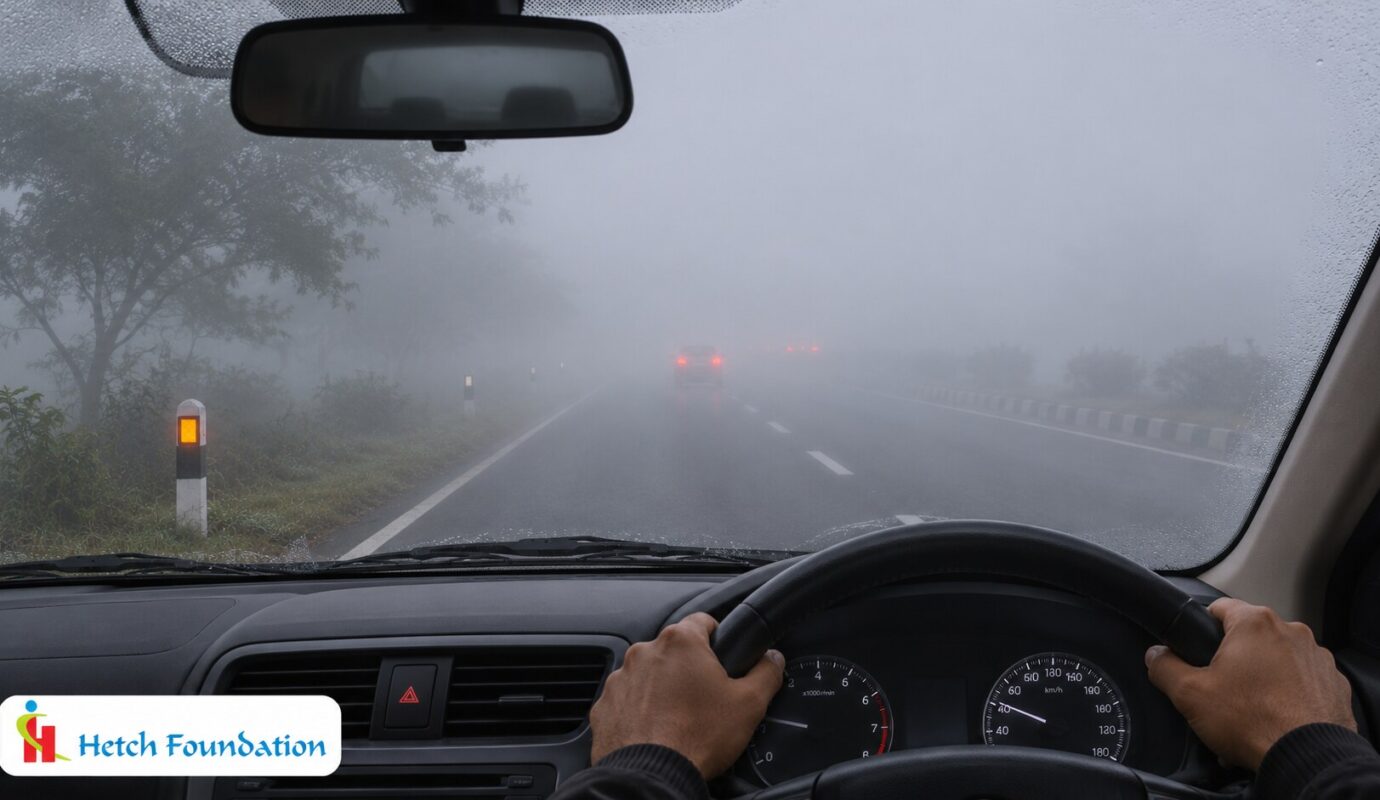
Why Following Tail Lights in Fog Can Mislead You
By Hetch Foundation
Two red lights appear ahead, fade, then return. On a clear road you could see the outline of the vehicle and the space around it. In fog, those lights may be all you see. That makes them tempting to follow. It also makes them a poor guide to the distance you need, the lane you are in or what might be stopped between you and them.
The driver in front cannot see through the fog any better on your behalf. Their braking decisions, view of the road and route are their own. Keep enough space and choose a speed that lets you stop within the road you can see to be clear. If the visible stretch gets shorter, slow early and allow the gap to grow. Where the conditions make continuing unsafe, use a suitable place off the road to wait.
Why the lights can look more certain than they are
Tail lights tell you that a light source is visible. They reveal less about the vehicle’s shape, speed and position when the rest of it is hidden. In patches of fog, the same lights can appear brighter or dimmer without the vehicle changing speed. A separate set farther away may appear to belong to the same car. If traffic has stopped, the time available to identify the queue may be shorter than the brightness of the lights suggests.
Look for the lane and road edges as well as the traffic ahead. Visible markings and reflectors can help you read the layout, but sections may be worn, hidden by moisture or interrupted at a junction. Give yourself time to recognise what the markings are doing. If a vehicle ahead leaves its lane for an exit, you need enough space to continue in yours without following it by reflex. On an unfamiliar stretch, check the route before setting off so that you know which decisions to expect.
A vehicle behind you may be relying on your lights in the same way. Keep your movements predictable and adjust speed early when conditions allow. A close follower creates pressure to keep moving faster than the visible road allows. Give yourself more space in front and use a suitable safe and lawful place to stop if you need to wait for conditions to improve.
Prepare the car while it is still parked
Check local forecasts and traffic notices before an early morning or night trip. If the journey can wait, delaying it until visibility improves is a practical option. For a necessary trip, identify places where you can leave the carriageway safely, such as an open service area with proper parking. Give people who are waiting for you a flexible arrival time so you can slow down or pause without feeling obliged to make up the time later.
Know how to operate your dipped headlights, demister, wipers and any fog lights fitted to the car. Clear the inside and outside of the windscreen before moving, and clean the lights when stopped safely. Use dipped headlights in fog and use fog lamps, if fitted, in accordance with the vehicle instructions and applicable rules. High beams can scatter light back towards you and make it harder to see the road. When visibility improves, switch off fog lamps as appropriate so they do not dazzle or confuse other drivers.
Some automatic light settings react to the amount of daylight rather than how far you can see. Check what lights are actually on, including at the rear. Learn the controls before the trip so that a patch of fog does not become the first moment you need to find them. Ask a passenger to handle messages or route updates as needed while you pay attention to the road.
Reassess when the fog changes
Fog varies along a route. An open section can lead into a dip or stretch near water where visibility changes suddenly. Ease off before entering a visibly thicker patch where you can and increase the space you leave ahead. Avoid an overtake when you cannot see the whole path or establish that it is clear. A slow-moving vehicle in front may be responding to something you cannot yet see.
Take extra care near crossings, work zones, median openings and toll approaches. Vehicles may be stationary and people may be outside them. Plan to recognise signs and use your indicators in good time. If you miss an exit, continue lawfully and reroute once you can do so safely. Use the visible lane and the signs, even if a navigation instruction comes late or the vehicle ahead takes a different path.
If the conditions make it unsafe to continue, look for a safe, lawful place well away from moving traffic. A service area or suitable off-road parking gives you a place to stop and reassess. Avoid stopping for a planned pause in a live lane or on a high-speed shoulder. If you are forced to stop in a dangerous position, make the vehicle visible where possible and contact emergency help from the safest place available.
Road authorities can help by maintaining reflective markings, signs and lane edge markers that drivers need in poor visibility. A recurring problem at a junction or diversion can be reported with the location, direction and conditions in which it occurs. Describe the sign or marking that becomes hard to see and whether the problem affects both directions of travel. That gives the operator a useful starting point for a check.
Can I keep up with a driver who seems to know the road?
Set your own pace based on what you can see and the room you need. Another driver may be going too fast for your view or may turn off without warning you can see in time. A larger gap allows you to make your own decisions as the fog changes.
What if I see brake lights suddenly appear far ahead?
Ease off early where conditions allow and prepare for a queue or stopped traffic. Continue watching the road and the vehicles closest to you. The clearer you make your own movement to the driver behind you, the more time they have to respond as well.
Before the next foggy trip, check where you can stop and how you will control your lights. Once on the road, let your own visible stopping space determine your pace.