

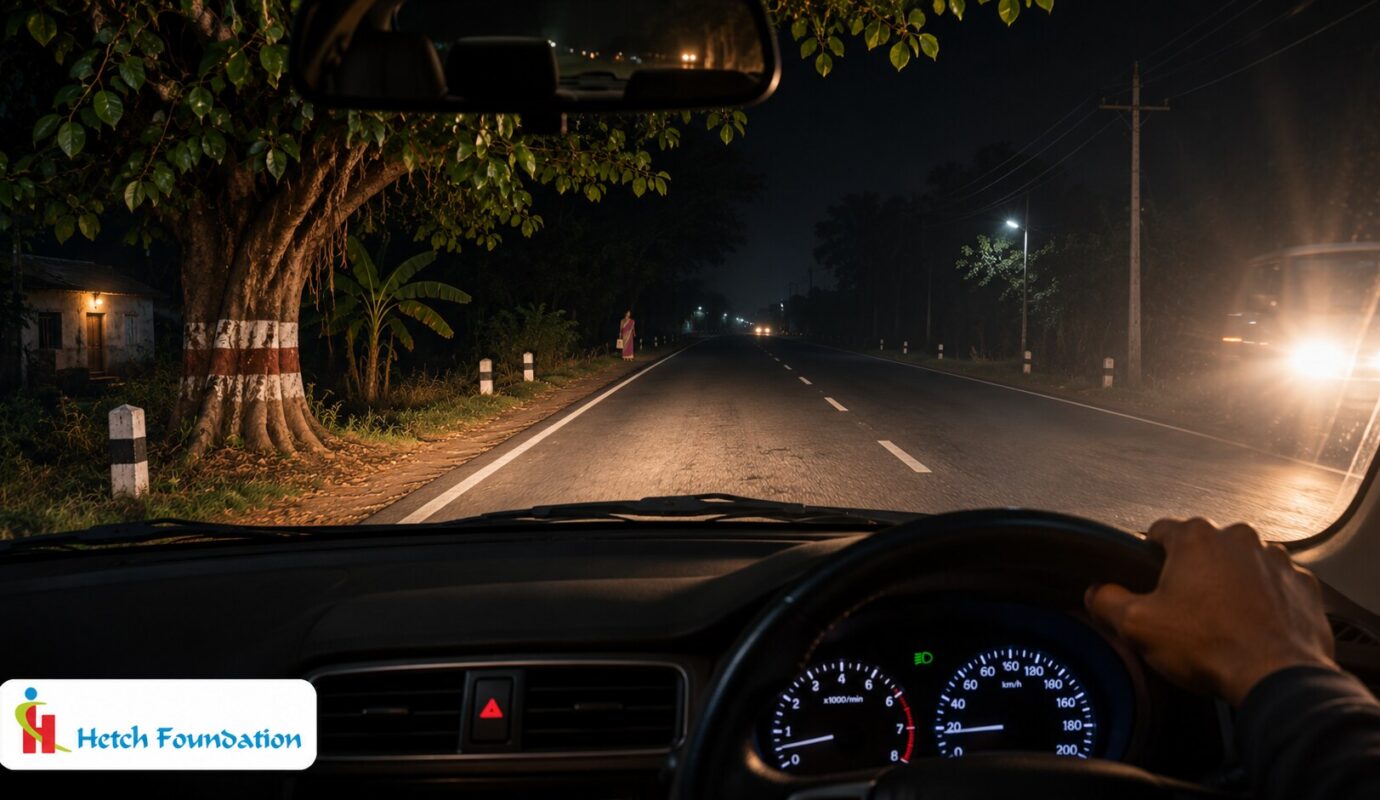
What Headlight Glare Hides for a Few Seconds
By Hetch Foundation
You are driving home after dark on a road you normally use in daylight. An approaching vehicle’s lights are bright enough that the edge of your lane becomes hard to see. The vehicle passes, and for a moment the road still looks darker than it did before. Somewhere in that darker section could be a person walking, a parked scooter or the beginning of a bend. Give yourself time to see it before you reach it.
Headlight glare is a problem of contrast. The bright part of the scene draws your eyes while details in the darker areas become harder to distinguish. People in dark clothing, faded markings and the edge of an unlit road can all be harder to pick out. The effect changes with the direction of the lights, the surface of the road and the condition of the windscreen. It can outlast the moment when the approaching vehicle is directly in front of you.
Adjust before you lose the edge of the road
As a bright vehicle approaches, ease off smoothly and increase your following space if there is traffic ahead. Keep looking at the road and your lane rather than directly into the approaching lights. A visible near edge marking can help orient you, but continue scanning for people, vehicles and changing road geometry. If you can see less of the road, allow more time to recognise whatever comes into view. A familiar stretch can still contain a new obstruction.
Avoid a sudden movement towards the roadside to get away from the bright light. The verge may be uneven, and someone walking or riding there can be difficult to see. Maintain a predictable position within your lane. If the glare or another visibility issue makes it unsafe to continue, look for a place where you can leave traffic and stop safely and lawfully. Give yourself time to reassess once parked, instead of trying to judge the severity while the road is changing in front of you.
Rain can make the same stretch harder to read. Reflections on wet pavement may make markings less distinct and add several bright points to the scene. Brake lights and streetlights can also reflect off wet surfaces. Slow early when those reflections make it harder to separate the lane from the surroundings. Leave enough room to respond smoothly if the next vehicle begins to slow or turn.
Use your own lights with other road users in mind
Know how to switch between main and dipped beam in the vehicle you drive. Use dipped headlights when approaching oncoming traffic or following another vehicle where glare could affect the other driver. Use main beam only where lawful and when it will not dazzle others. A rider, pedestrian or cyclist on the road also needs to be able to see. The aim is to light the road ahead while preserving other people’s ability to judge where they are going.
Avoid answering glare with more glare. Trying to send a message with a bright beam can make it harder for both drivers to see the same section of road. Adjust your own speed and leave room instead. If a vehicle behind is dazzling you, keep your movements predictable and use your mirror’s anti-glare setting if fitted and appropriate. Stop in a safe place if you need to adjust equipment or check a control you cannot operate safely while moving.
Have your headlights checked if other drivers frequently signal to you or your beams appear unusually high or uneven. Loading the vehicle can change its attitude and affect where the beams point. Follow your vehicle manual for any adjustment the driver can make and have alignment or repairs checked by a qualified service provider. Keep lamp covers and both sides of the windscreen clean. Smears, condensation and worn wipers can make glare worse precisely when you need a clear view.
Watch for the people and places that disappear first
Near a bus stop, market or village approach, someone may be waiting close to the edge of the road. Look for the place they are likely to cross and adjust your pace before it enters the brightest part of the scene. At a junction, another car’s headlamps may face you while it waits to turn, making it harder to notice a scooter or pedestrian beside it. Take time to scan the area beyond the lights as they pass or change direction.
If you are walking, use a footpath or clear protected area where available. Recognise that a driver facing bright lights may take longer to see you. Wait at a crossing where you can check the approach and stay clear of traffic until it is safe to cross. Drivers and road owners share responsibility for making the crossing visible. A report can help identify whether the lighting shines in a driver’s eyes while leaving the waiting area in shadow.
Road authorities can assess night visibility from different approaches. A crossing may be easy to recognise in daylight but hard to distinguish against oncoming light at night. Check sign condition, lane markings, lighting direction and whether a parked vehicle regularly obscures the edge. If you report a recurring issue, give the position, direction and time, and describe what becomes difficult to see. You can make that observation from a safe public place.
What if I know the road extremely well?
Use your knowledge of where a bend or crossing is to slow early, then drive to the conditions you can see. Familiarity does not reveal a person walking home, a new closure or a vehicle stopped around the bend. Leave enough time for these ordinary changes.
Does a brighter replacement bulb always improve visibility?
Check the vehicle manufacturer’s specifications and applicable requirements. Beam shape and alignment matter alongside brightness. A poorly matched or aimed lamp can throw light where it dazzles others or fails to illuminate the part of the road you need. Have any replacement checked for suitability and correct alignment.
Before your next night trip, clean the windscreen and learn the beam controls while parked. On the road, slow early when glare reduces the view and allow time to see the darker part of the scene after the approaching vehicle passes.