

How Children Build Road Safety Habits: Lessons From HarGhar Se EkSainik
The shop is five minutes away. A child climbs into the back seat and sees the driver pull out before everyone is buckled. Later that week, on a longer trip, the same adult insists that every passenger fasten up. What does the child take from those two journeys? They may decide that seat belts are for highways, long drives or occasions when someone makes a fuss. The adult may never have said any of that. The child has worked out the rule from what happened in front of them.
In HarGhar Se EkSainik, Syed Abdul Hakeem asks readers to think about what children learn on ordinary journeys. Chapter 7 describes the back seat as a classroom where the adult constantly demonstrates what deserves attention. The book also makes room for learning on foot, at school and at the front door, where a child can remind a parent to wear a helmet. These examples offer families and schools a practical starting point. Choose one action children can observe, explain it in ordinary language and repeat it until it belongs to the routine.
Give children one rule they can see adults follow
Start with the moment before the car moves. The driver can say, “We’re ready when everyone is buckled,” then wait while the adults secure themselves and check that each child is correctly secured in an appropriate restraint. For a child who needs a car seat or booster, choosing and fitting it according to the manufacturer’s instructions remains an adult responsibility. An older child can practise buckling independently when their restraint allows it, with an adult checking that it fits correctly. The sequence is easy to recognise because the vehicle stays parked until everyone is ready.
The book’s short-trip example matters because the corner shop is usually where the routine gets tested. A family may be careful on a long drive, then skip steps when it is only going down the lane. Try making the check the same for the school run, a visit to a neighbour and a weekend outing. If a cousin joins or a grandparent drives, explain the family routine before anyone gets in. That way, a child sees the same action across several situations and learns where the rule begins and ends.
Parents can do the same with a phone. Set the route before leaving and put the phone away before moving. If a change needs attention and a passenger cannot handle it, pull over and park safely first. When a call comes in, a calm “I’ll return that after we park” gives a child an example of how an adult deals with an interruption. Later, the child can describe what they saw in their own words. Their explanation tells you more than a quiz asking whether phones are distracting.
Talk through one real crossing on the school route
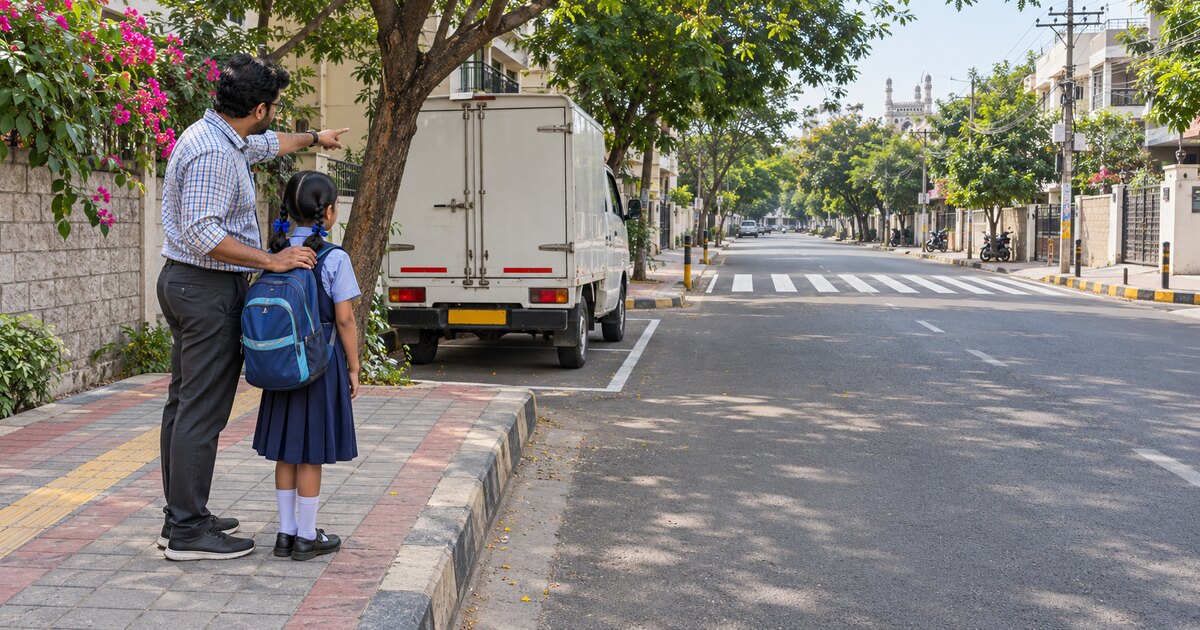
In Chapter 7, an adult explains why they pause at a crossing where a wall makes it hard to see a bicycle approaching. The value of the example is its specificity. The child can see the wall, understand what it hides and connect waiting with a reason. On a familiar walk, you might stop well back from the road and say, “That parked van blocks our view. Let’s go to the crossing where we can see approaching traffic.” Then walk there together and show the child what you are checking before you cross.
Keep the explanation short enough to follow while outdoors. Ask one question from a safe spot, such as “What can you see coming from that side?” or “Which place gives us a clearer view?” Listen to the answer and add the detail the child missed. A vehicle can turn into the street, and a motorcycle can be hard to see beside a larger vehicle. Use a designated crossing where available, follow the signals, check traffic in all relevant directions and start crossing when it is safe. The adult chooses when to go and supervises the crossing.
Repeat the exercise on a quieter day, when the child can pay attention and the family has time to wait. Caregivers can also walk the route before school starts to identify where cars reverse or footpaths narrow. If the usual route has poor visibility, pick a safer crossing or meeting point, even if it adds a little distance. When a route offers few safe options, adults can coordinate with the school about where families wait and where vehicles stop. Teaching a child to look carefully goes hand in hand with giving them a safer place to practise.
Let children speak up and show them what happens next
One of the book’s most memorable examples takes place at the doorway. A child asks a parent to wear a helmet before leaving. The important part comes after the reminder. The adult listens, puts the helmet on and fastens it before riding. When a family uses a two-wheeler, adults can make properly fitted, fastened helmets part of the routine for the rider and passenger, and plan another way to travel if they cannot provide appropriate protection for a child.
Give children a phrase they can use comfortably with a trusted adult. “Can we buckle up first?” works before a car leaves. “Can we cross together?” works when a child is unsure. The adult’s response can be just as simple. “Thanks for saying that. Let’s check.” A calm answer makes it easier for a child to raise a concern the next time. Caregivers can explain the same routine to grandparents, older siblings and others who take the child to school so the child hears a consistent message.
Adults remain responsible for safe decisions, even when a child is quiet, asleep or too young to speak. Avoid giving children the job of monitoring another adult or asking them to correct a stranger. If a driver regularly takes calls while moving or a school transport arrangement keeps raising concerns, caregivers should speak directly with the operator or school. A child who mentions a worry has already done enough. The adult can follow up and tell the child, in simple terms, what has been arranged.
Make the school lesson a rehearsal
The book proposes game-based learning in which children make choices in a simulated road setting. A school can borrow that idea in a classroom or a closed courtyard. Mark a footpath and crossing with tape. Set up a cardboard vehicle or a chair to represent a parked van. Ask pupils to decide where they would wait for an adult and which crossing gives them a clearer view. Nobody needs to race, step into traffic or act out a crash. A teacher can pause the exercise and ask a pupil to explain the decision to a partner.
Run the same situation twice with one detail changed. On the first round, the crossing is clear. On the second, a large object blocks the view or a classmate moves a model vehicle toward the crossing. Ask what changed and how that affects the decision. A pupil who can explain why they would wait is showing a skill that can travel beyond the exercise. Older pupils can draw the approach to their school gate and mark a place with poor visibility, then share the drawing with a teacher who can inspect it.
End with a task pupils can do with a caregiver, such as pointing out one crossing they use or explaining the family’s before-the-car-moves routine. Make room for children who walk, take school transport or travel with different caregivers. They can describe an equivalent habit from their journey. At dismissal, adults should provide the example pupils have just rehearsed. A clear waiting area and staff who help keep children away from reversing vehicles make it easier for families to practise the routine under real conditions.
Adapt the routine as children grow
A younger child can learn one short instruction and repeat it with a trusted adult. “We stop here and wait together” is easier to remember than several rules given at once. Let the child point to the crossing or show you where to stand while you stay beside them. For children who communicate or learn differently, use whatever helps them recognise the routine. A picture of the usual waiting spot, the same phrase each day or a practice trip when the street is quieter can make the sequence easier to follow.
A school-age child can begin to explain why a familiar spot is difficult. Ask them to show you what a parked vehicle hides from where they stand. They may see less than an adult standing in the same place. Give older children a say in planning where to meet after school or which route has better visibility. Discuss what to do when friends rush ahead or when a pickup point changes. A teenager can practise sending a message about a changed meeting point before leaving a safe place. The level of independence should fit the child and the route, with caregivers making that decision.
Although the chapter title puts the emphasis on starting young, families can begin at any age. A move, a new school term or a change in who does pickup gives everyone a reason to agree on a fresh routine. An adult can say, “I used to check my map while moving. From now on I’ll set it before we go.” It helps to follow through on the next trip, when the child can see what the change looks like.
Try one habit for a week
Pick a routine that fits a trip you make often. If the car is your usual way to school, choose the buckle check. If you walk, choose one crossing to practise with your child. On the first day, do the action and explain it in one sentence. On the next few trips, repeat it at the same point. Near the end of the week, ask the child what happens next or what you are looking for. Use their response to judge whether your explanation was clear and what you should demonstrate again.
Make the action easier to repeat when the day gets busy. Keep helmets where adults can reach them before leaving. Agree on a pickup point that keeps children away from moving vehicles. Set the destination before driving. Ask the adult collecting the child to use the routine you have agreed on. If you miss a step, make the correction visible. If the car is still parked and someone is unbuckled, wait while everyone is secured. Say what happened and carry on. Your child has now seen how a hurried adult can recover the routine calmly.
At the end of the week, ask two questions in the household. Did the adults do the action on the short trips? Did anyone have trouble doing it when the route or caregiver changed? The answers can point to an adjustment that matters more than a sticker chart. You might move a helmet closer to the door, leave a few minutes earlier for a safer crossing, or brief a relative before the next pickup. Keep practising the first routine before adding another one. A week gives you a chance to spot what gets in the way and decide what to keep doing.
Carry the lesson into the next ordinary trip
A child who hears an adult explain a crossing can watch the adult wait for a safe moment. A child who asks about a helmet can watch the adult fasten it. And a child in the back seat can see that everyone buckles up before a drive of five minutes. These moments are familiar enough to repeat tomorrow, and that is their strength. Choose one trip this week and decide what you want your child to see you do on it. Then give them the same example the next time you leave together.
About the book
HarGhar Se EkSainik: Save Lives, Save Nation by Syed Abdul Hakeem examines how ordinary choices shape road culture and what households can do to protect people on the journeys they share. This article draws on Chapter 2, “The People We Forget Are There,” and Chapter 7, “The Window That Closes At Fourteen,” especially their examples of the back seat, a crossing with limited visibility and a child reminding an adult to wear a helmet.
Explore Hetch Foundation’s HarGhar Se EkSainik road safety campaign.
Road safety guidance · Delhi Traffic Police general safety guidelines · WHO occupant restraints manual