

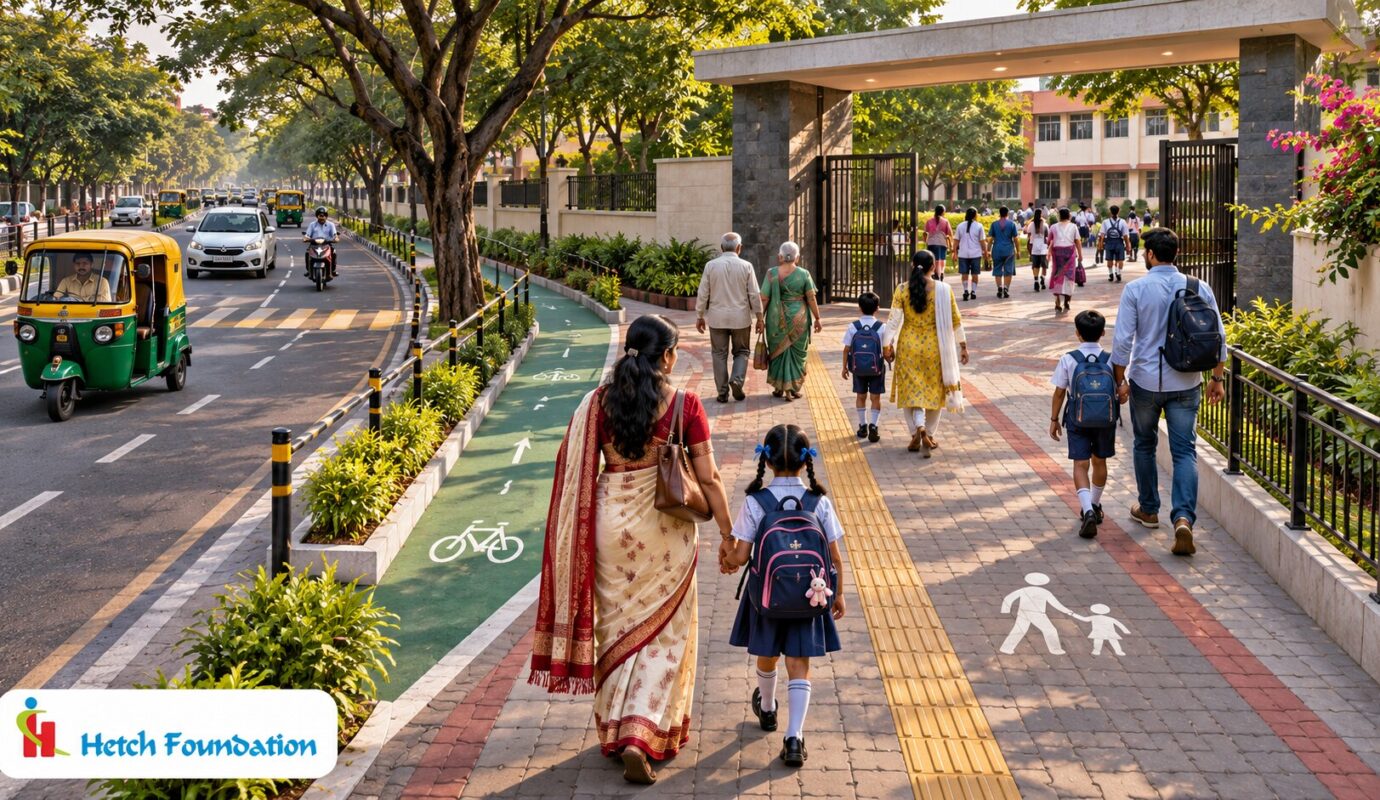
Why a School Gate Becomes a Traffic Problem
By Hetch Foundation
At school pickup, a parent waits on a scooter, an auto-rickshaw slows near the gate, and a car backs out of a space. A family walking home tries to reach the footpath on the other side of the waiting vehicles. Everyone is doing something ordinary. The problem is that the same stretch of kerb has become a waiting area, a turning area, a pickup point and a walking route, all within a few minutes.
A school gate is one point in a much longer journey. Children may come by bus, on foot, with relatives or in shared vehicles. The route has to work for the person who uses a wheelchair, the grandparent who walks slowly, and the family arriving on a busy road with no convenient place to stand. The best place to begin is to see how those journeys meet before looking for a change.
Look at the busiest minutes from the footpath
Stand in a safe public place outside the gate during arrival or dismissal. Watch where children are already walking and where drivers stop. Note the stretches where the walking route disappears behind parked vehicles. A crossing can be clearly visible from the gate and still be difficult for a driver to see from behind an auto-rickshaw or van. Observe the route at another time too. A quiet midmorning visit may reveal a narrow kerb but tell you little about which part of it becomes blocked at dismissal.
Sketch the street in simple terms. Mark the gate, nearby driveways, crossings, bus or van stops, and places where people wait. Identify the points where children have to walk behind reversing vehicles, pass through a queue or step down around an obstruction. Note the time and direction from which traffic approaches. Keep children and families out of identifiable photos where possible, and avoid taking photos from the road. A clear description of the movement is usually enough to begin a conversation.
Include people who use the route differently. A parent who drives may know exactly which side the pickup line forms on. A person who walks can tell you whether the route from a side street is continuous. Someone who uses a mobility aid can show where a ramp is missing or where the waiting area narrows. Bringing those accounts together helps the school identify the problem people are actually encountering instead of solving only the easiest part to see.
Separate waiting, walking and vehicle movement
A first improvement might be to keep a defined stretch of kerb at the gate clear. This can help people see the exit and make it easier to reach a nearby crossing. Where the site allows, designate a place for permitted brief stops away from the crossing and leave enough space to move along the footpath. Ask the responsible road or traffic authority to check where that can be done safely. Moving a queue around the corner is useful only if the new location does not block another crossing or residential access.
Review the paths used by buses and vans. Ask where they can pick up without crossing the main line of children on foot, and where waiting adults should stand. If a vehicle must turn within a site, look at whether the turnaround can operate apart from the walking route. Where the road is public, any cones, markings or changes in circulation should be agreed with the responsible authority and designed for local access needs.
Clear instructions can reduce last-minute stops. Give parents and van drivers a simple description of the right approach and pickup point. If a school uses multiple gates, make each route easy to identify, and provide an accessible option. Write the instructions for a substitute driver or a relative who has never visited. The first trip should be possible without someone trying to read a message while waiting beside the gate.
Small changes drivers and walkers can make today
If you drive, leave time to use the designated pickup point or park lawfully and walk. Approach the area slowly and watch between stopped vehicles, across driveways and beside the gate. Allow people time to finish crossing. Make sure passengers enter and leave from a safe position. If the pickup point is blocked, continue to a lawful alternative instead of stopping in a place where a child has to cross between vehicles to reach you.
If you walk the route with a child, practise it at a calm time. Point out the places where a vehicle can turn into a driveway and where the view from the kerb changes when a larger vehicle stops. Use a clear, accessible crossing where available. Ask the school where adults should wait so that children can find them without walking through the vehicle queue. A consistent meeting point can be easier to remember than a series of messages sent when both sides are already on the move.
Decide how to tell if the change helps
Choose one difficult movement to track, such as people stepping into the road around vehicles waiting on the footpath. Observe it before and after a trial at comparable times. Ask whether the route is easier to see and use for people who walk or move more slowly. Check adjacent streets and other school gates, since congestion or conflicts can move to another place. Share what you observed with the school and the authority responsible for the road.
If the problem persists, a professional assessment can consider crossing placement, lower vehicle speeds, usable kerb ramps, walking space and signal timing where relevant. Keep sight of the full journey from nearby bus stops, residential streets and crossings. A convenient pickup zone has limited value if people still need to cross a busy approach with nowhere safe to wait.
Two questions parents often ask
Is it safer to stop right outside the gate?
A suitable designated stop can help when it keeps walking routes and crossings clear. At many gates, however, stopping at the front takes away the space people need to see or move. Follow the school’s agreed arrangements and choose a lawful spot from which the child can reach you safely.
Who should hear about a recurring problem?
Tell the school about what happens on the walk or at pickup. For changes to a public street, include the relevant traffic or road authority. Give the exact place, time and movement that causes difficulty. A description such as “children come around the waiting vans to reach the crossing just after dismissal” gives everyone a starting point.
At the next pickup, follow the route a person on foot has to take from the gate to the next crossing or street corner. The first place where that route becomes hard to use is a concrete place to start.