

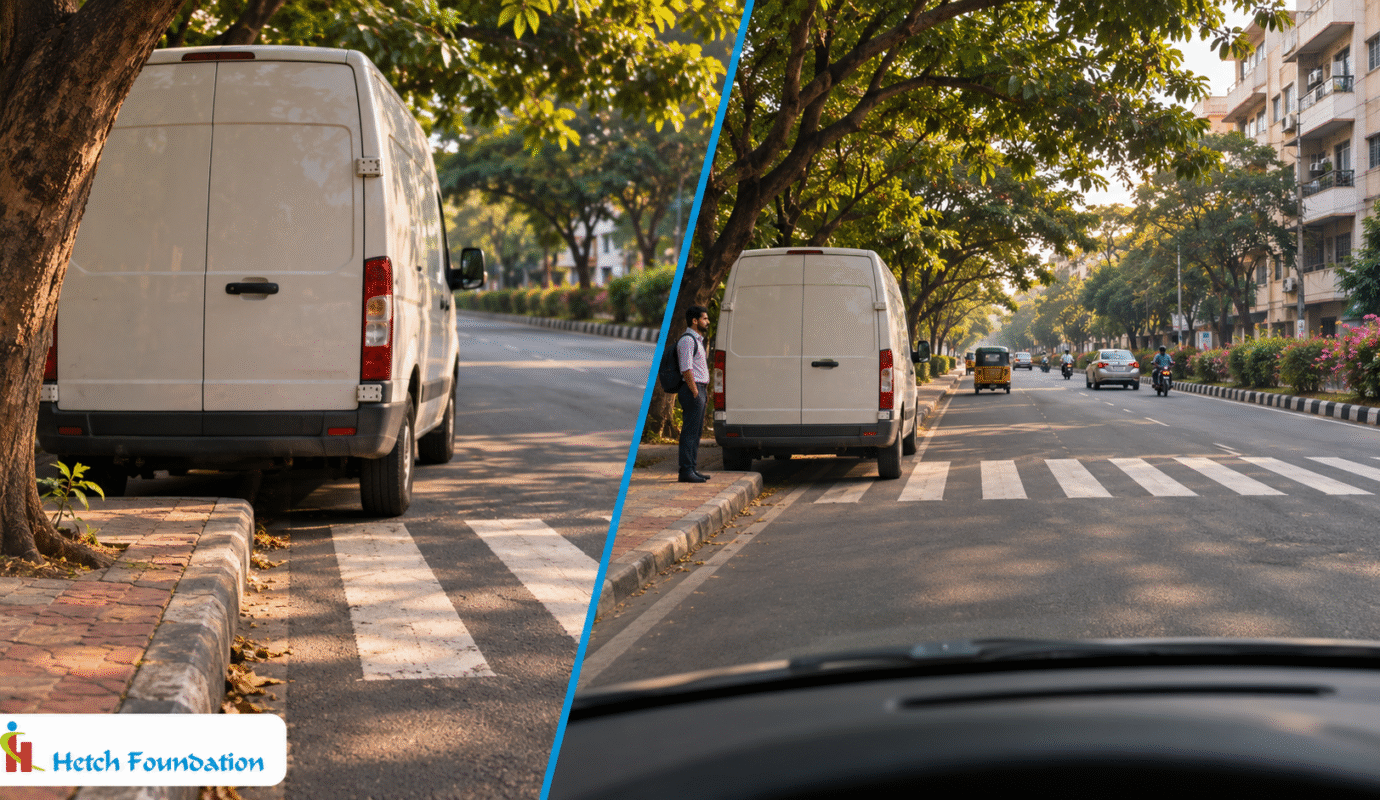
When the Zebra Crossing Is Hidden
By Hetch Foundation
You reach the zebra crossing outside a row of shops. The white stripes are there, but a delivery van is parked right up against them. From the footpath you can see the back of the van and a sliver of the road. From an approaching car, the driver can see the van but may see you only once you step beyond it. Both of you are trying to make a decision with part of the street hidden.
That is the problem with a blocked zebra crossing. A marked crossing should give people a predictable place to cross. When parking, loading, roadside displays or temporary barriers block the view, the person walking and the person driving have less time to see each other and respond. A familiar street can feel quite different once you look at it from both sides of the windscreen.
What the van hides from both sides
Picture the crossing from the kerb. A person waiting beside the van needs to see approaching traffic before stepping off. Meanwhile a driver needs to see the part of the footpath where someone might be waiting. The same parked vehicle interrupts both lines of sight. The problem can be more pronounced for a child, a wheelchair user or someone seated on a mobility scooter because their view is lower.
A parked vehicle is only one example. A line of auto-rickshaws, a large roadside display or an opaque barrier around roadworks can have the same effect. Even when the stripes are freshly painted, the driver may spot the marking before seeing the person who intends to use it. An approach that seems clear from an adult’s standing height can hide a great deal at the height of a car seat or a wheelchair.
There is a second blind spot on roads with more than one lane in the same direction. A driver in the near lane may stop for a pedestrian, while the stopped vehicle blocks the view from the next lane. This is why a person crossing still needs to check the next lane, and why drivers should slow down when a vehicle beside them has stopped at a crossing. Each lane needs its own clear view.
If you are walking, look for a clear view from the footpath
Pause before stepping down. From a safe position on the footpath, look for traffic from both directions, including vehicles turning in from side streets. At a signal-controlled crossing, follow the pedestrian signal and check that vehicles have stopped or are yielding before entering. At any crossing, continue to check each lane as you move across. A visible driver or a raised hand gives you limited information about what traffic in the other lanes is doing.
If the obstruction leaves you unable to see approaching traffic without entering its path, stay back and look for a safer crossing nearby. A signal-controlled crossing with an unobstructed approach may offer a clearer view. Choose a route you can actually use. An inaccessible footbridge, a high kerb or a broken approach can make a suggested detour impractical for someone using a wheelchair, walking aid or pram.
When walking with a child, stop together at the kerb and show them the part of the road you need to see. On a familiar route, practise pointing out the turning lane and any parked vehicles that hide traffic. Give older adults and people moving more slowly the time they need to choose a gap and complete their crossing.
If you are driving or riding, slow down before the crossing
Treat a blocked view as a reason to slow down early. Look for crossing signs, stripes, kerb ramps and the places where people approach the road. Keep your attention on the space beside and just beyond any parked vehicle. Approach at a speed that gives you time to respond to someone coming into view. As the space you can see gets shorter, leave yourself more time by reducing speed.
Yield to people using the crossing and stop before it when needed, leaving the marked area clear. If traffic is queued beyond the crossing, wait until there is room for your entire vehicle on the far side. A vehicle stopped across the stripes can send someone around its front or rear, where another driver may have even less time to see them. On a multilane road, give a stopped vehicle beside a crossing room and avoid passing it at the crossing.
The same applies on a motorcycle or scooter. A narrow gap beside a stopped vehicle can look open from the saddle while hiding a person already crossing. Ease off before you reach the crossing and allow time for walkers to clear your path. If you are carrying a passenger, keep the ride predictable by slowing early and smoothly.
Give the crossing a clear approach
A shop, apartment complex or delivery team can help by choosing a loading point that leaves the crossing and its approaches visible. When arranging a pickup, tell the driver where they can stop safely without blocking the stripes, kerb ramp or pedestrian approach. The same habit helps outside schools, clinics and bus stops, where several people may arrive at once and crowd the space where others need to wait.
Some problems need a street-level fix. Traffic and road authorities can review where parking is allowed, whether restrictions are visible and enforced, and whether lighting reveals people waiting on both sides. Depending on the site, a properly designed raised crossing, kerb extension or refuge island may shorten the crossing, improve visibility or help manage vehicle speed. The right design depends on the road, available space, drainage and access needs.
If the same obstruction keeps appearing, record the location, direction of approach and time of day from a safe public position. A photo taken from the footpath can show the blocked sightline. Send the details to the local traffic police or the authority responsible for that stretch. A specific report such as “delivery vehicles block the west approach most weekday mornings” gives the authority something it can check.
Two questions people often ask
Can I cross if a driver waves me through?
A wave tells you what one driver intends to do. Take a moment to check for traffic in the next lane, including scooters passing a queue and vehicles making a turn. Continue when you can see that your route is clear and crossing is permitted. If another lane is hidden, wait in a safe place for a clear view.
What if I can see the stripes but there is no proper place to wait?
Look for an accessible alternative with space to wait and a clear view of traffic. If the crossing serves a school, clinic, market or bus stop, report the missing waiting area or kerb ramp as part of the problem. Describe where people actually come from and where they need to go. That helps an authority assess whether the layout serves the people who use it.
On your next regular walk, take a moment to look at one crossing from the footpath. Can you see approaching traffic without stepping off the kerb? Can drivers see where you are waiting? If either view is blocked, you have identified a specific problem worth reporting.